

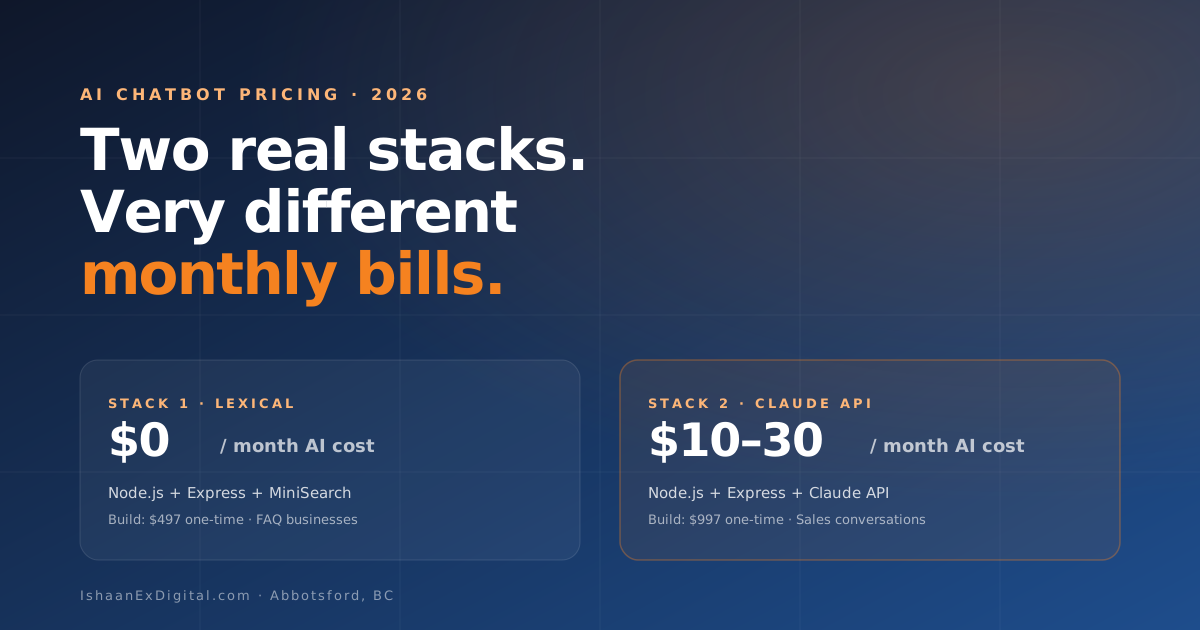
Most guides on AI chatbot pricing for a small business website skip the question that actually matters: which stack are you paying for? A chatbot built on a curated answer file is a different product from one built on the Claude API. They look identical to a visitor. They cost very different amounts to build and run. This post breaks down both, with real numbers from the chatbot we built for our own site.
The chatbot on the bottom-right of this page is one I built and run myself. It costs $0 in monthly AI fees because I chose the lexical stack on purpose. We also build the Claude API version for clients who need it. By the end of this post, you will know which one fits your business and what the honest price tag looks like for each.
What does AI chatbot pricing actually look like in 2026?
AI chatbot pricing for a small business website breaks into two costs: the one-time build and the monthly running cost. The build is what you pay an agency or freelancer to set the chatbot up. The monthly cost is what you pay the AI provider (Claude, OpenAI, or none, depending on stack) once the chatbot is live.
A lexical chatbot costs $0 per month in AI fees because it does not call a language model. It searches a curated file of approved answers and returns the best match. The build cost from a Canadian agency lands around $497 one-time.
A Claude API or OpenAI chatbot costs $10 to $30 per month in API fees at typical small business volume — under 1,000 conversations per month. The build cost is higher because of the prompt engineering and safety testing involved. It lands around $997 one-time plus the client's direct API account.
Stack 1 — Lexical search (the free AI chatbot for website builds)
A lexical chatbot is not what most people would call "AI." But the market uses the term, and the result is functionally the same to a visitor. The stack is small: Node.js as the runtime, Express as the web server, a search library like MiniSearch, and a JSON file of approved answers.
A visitor types a question, the server runs a search over the answer file, and the best-matching approved answer is returned. There is no language model involved. There is no monthly API bill. There is also no risk of the chatbot hallucinating, because it can only ever return answers you have already approved.
This stack fits businesses with predictable customer questions. Clinics, trades, contractors, dental practices, dog daycares, sanitation services. Anywhere the same five or six questions account for most of the inbound chat. An AI chatbot for customer support in those settings rarely needs more than a curated answer file.
Stack 2 — Claude API (when you need real conversation)
A Claude API chatbot adds a language model on top of the same Node and Express stack. Instead of matching the visitor's question against a fixed file, the server sends the question to Claude with a system prompt that tells the model how to answer. The reply comes back conversational, closer to how a salesperson would handle the same question.
The tradeoff is cost and risk. Every reply is a paid API call. At typical small business volume, that works out to $10 to $30 per month. The risk is hallucination. A language model can make claims that are not in your business reality unless the prompt is carefully written and the retrieval is locked to your real content. Adversarial testing before launch is mandatory.
The Claude API stack fits AI chatbot for ecommerce, AI chatbot for real estate, multilingual lead qualification, and longer sales conversations. The chatbot turns into a sales assistant rather than an FAQ desk.
How we built Stack 1 for our own website (one-week timeline)
I chose the lexical stack for our own site because most of the questions a visitor asks here are predictable. What we do, what it costs, where we are based, how to book a call. The full build took about one week.
The longest part was writing the curated answer file. The code itself is small: a Node and Express server, a search wrapper around MiniSearch, and a floating widget in plain JavaScript. The chatbot lives at a separate domain (chat.ishaanexdigital.com), so it can be embedded on any platform — this site, a client WordPress site, a Shopify storefront — using a single script tag.
The full case study with the verified stack table, the can-and-cannot list, and the tier comparison is here: How we built our own AI chatbot — the stack, the cost, the decision.
The real cost breakdown — Starter vs Pro
Here is the honest price comparison for what we sell to clients. The Starter tier is the same stack as the chatbot on this site. The Pro tier adds the Claude API for conversational depth.
Starter Chatbot — $497 one-time, $0 per month in AI fees. Built on Node.js, Express, and a search library. Answers from a curated file of approved facts. Best for FAQ-heavy small business websites where the same handful of questions drive most chat volume.
Pro Chatbot — $997 one-time plus client API costs. Built on Node and Express with the Claude API and retrieval locked to your business content. The client opens their own Anthropic account during onboarding and pays Claude directly for API usage, $10 to $30 per month at small business volume. We set up billing alerts and a hard cap so there are no surprises.
Both tiers ship with the same one-line script tag for the website embed, so the platform choice does not change the build price. Full pricing for everything we sell is on the IshaanEx Digital pricing page.
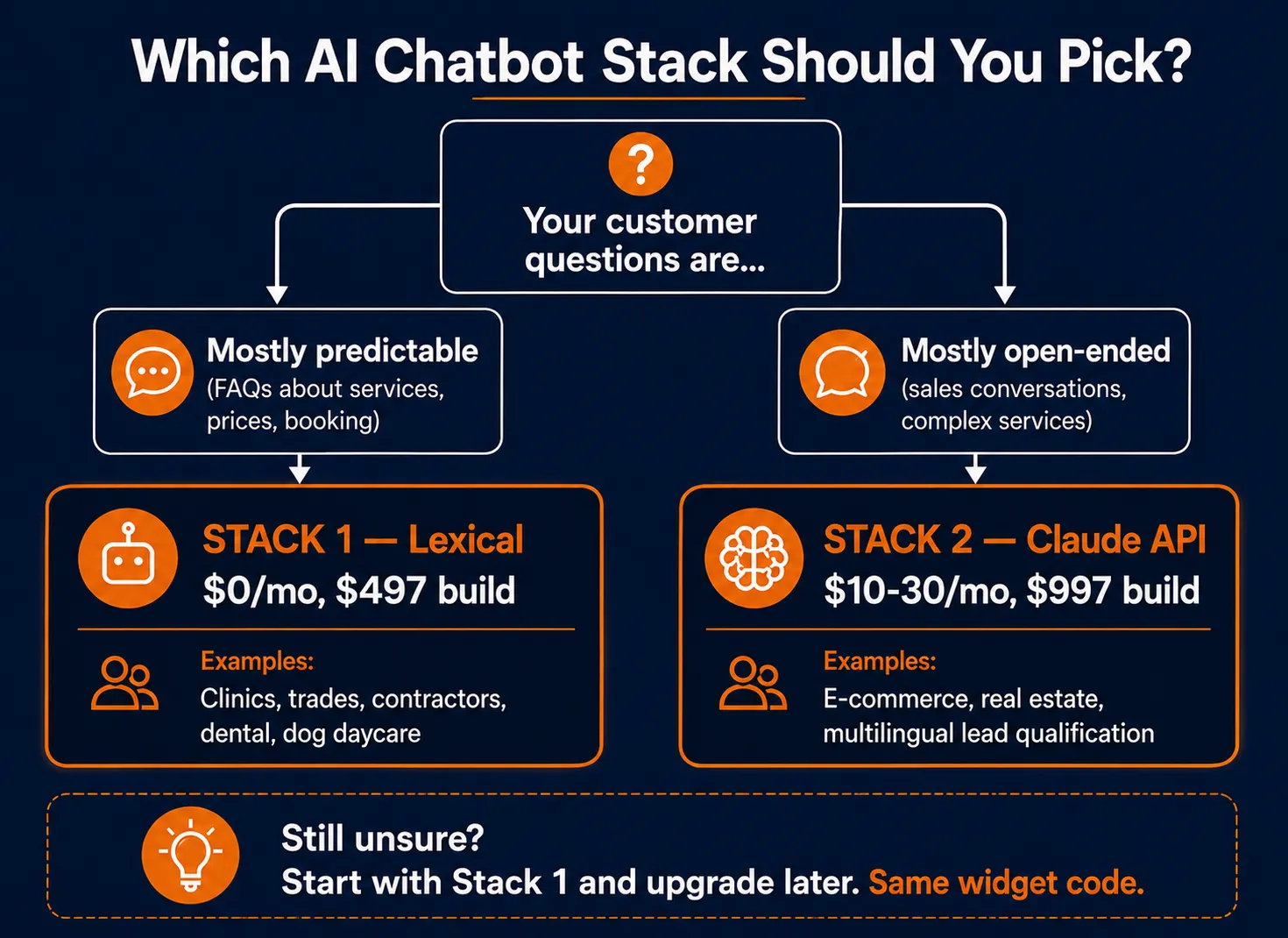
Which stack should you pick? (a decision tree)
The choice between Stack 1 and Stack 2 comes down to four questions. If you answer yes to most of the first set, the Starter lexical stack fits. If you answer yes to most of the second set, the Pro Claude API stack fits.
Pick Stack 1 (Lexical, $0 per month AI) if: Most of your inbound questions are predictable. Your customers are local and book by phone or form after a quick check. Your business runs on a short, stable set of services with set prices. You want zero ongoing AI cost.
Pick Stack 2 (Claude API, $10 to $30 per month) if: Your customers ask open-ended questions about complex services. You sell across more than one language. Lead qualification takes a real conversation before a human gets involved. The cost of a lost lead is much higher than $30 per month.
Not sure? Start with Stack 1 and upgrade to Stack 2 if the chatbot needs grow. The widget code is the same. Only the backend changes.
Will it work on WordPress, Shopify, or my custom site?
Both stacks embed via one script tag in your site footer. That means an AI chatbot built on either stack works the same on WordPress, Shopify, Wix, Squarespace, or a custom-coded site. The chatbot itself runs on a separate Node server. Your website just hosts the floating widget.
For an AI chatbot for WordPress, you add the script tag in your theme's footer.php or via a plugin like WPCode. For an AI chatbot for Shopify, you add it in the theme's theme.liquid file. For a custom-coded site like this one, you add it in the layout file. The chatbot does not care what platform is hosting the widget. Only that the script tag is present.
FAQs about AI chatbot pricing for small business websites
How much does an AI chatbot for a small business website cost in 2026?
An AI chatbot for a small business website costs between $0 and $30 per month in ongoing AI fees, depending on the stack. A lexical chatbot built on curated answers has $0 per month in AI fees because it does not call a language model. A Claude API or OpenAI chatbot costs $10 to $30 per month in API fees at small business volume (under 1,000 conversations a month). Build cost from an agency is a separate one-time fee, $497 to $1,500 depending on stack and scope.
Can I build a free AI chatbot for my website?
You can build a chatbot with no monthly AI fees by using a lexical search stack — Node.js or Python plus a search library like MiniSearch and a curated JSON file of approved answers. It is not powered by a language model, so there is no monthly API cost. The tradeoff is that the chatbot can only answer questions that match the answers you have written. For most small business FAQ use cases, that is enough.
What is the best AI chatbot for a small business website?
There is no single best AI chatbot — the best one depends on whether your business questions are predictable or open-ended. A lexical chatbot is best for FAQ businesses like clinics, trades, and contractors where 80% of questions are about services, pricing, and booking. A Claude API or OpenAI chatbot is best for businesses with longer sales conversations, complex services, or multilingual visitors.
Will an AI chatbot work on WordPress, Shopify, or a custom-coded site?
Yes. Both lexical and language-model AI chatbots embed via a single script tag in your site footer. WordPress, Shopify, Wix, Squarespace, and custom-coded sites all support this. The chatbot itself runs on a separate Node.js server — your website just hosts the widget. The same chatbot we built for our own custom-coded site would work the same way embedded on a WordPress or Shopify site.
How long does it take to build a custom AI chatbot for a website?
A lexical AI chatbot for a small business website takes about one week to build, test, and deploy. That includes writing the curated answer file, setting up the Node.js server, building the widget, and embedding it on the site. A Claude API chatbot takes one to two weeks because of the additional prompt engineering, retrieval setup, and adversarial safety testing required for language-model output.