
If you have searched "ecommerce web design Abbotsford", you probably want one honest number: what will an online store actually cost me? Most guides answer with a range so wide it is useless — $2,000 to $100,000.
This one is different, because I have the real numbers. I built and now run Scholars Hub, a live store with more than 200 products on Shopify. So the costs below are not guesses from a pricing page. They are what a real store pays.
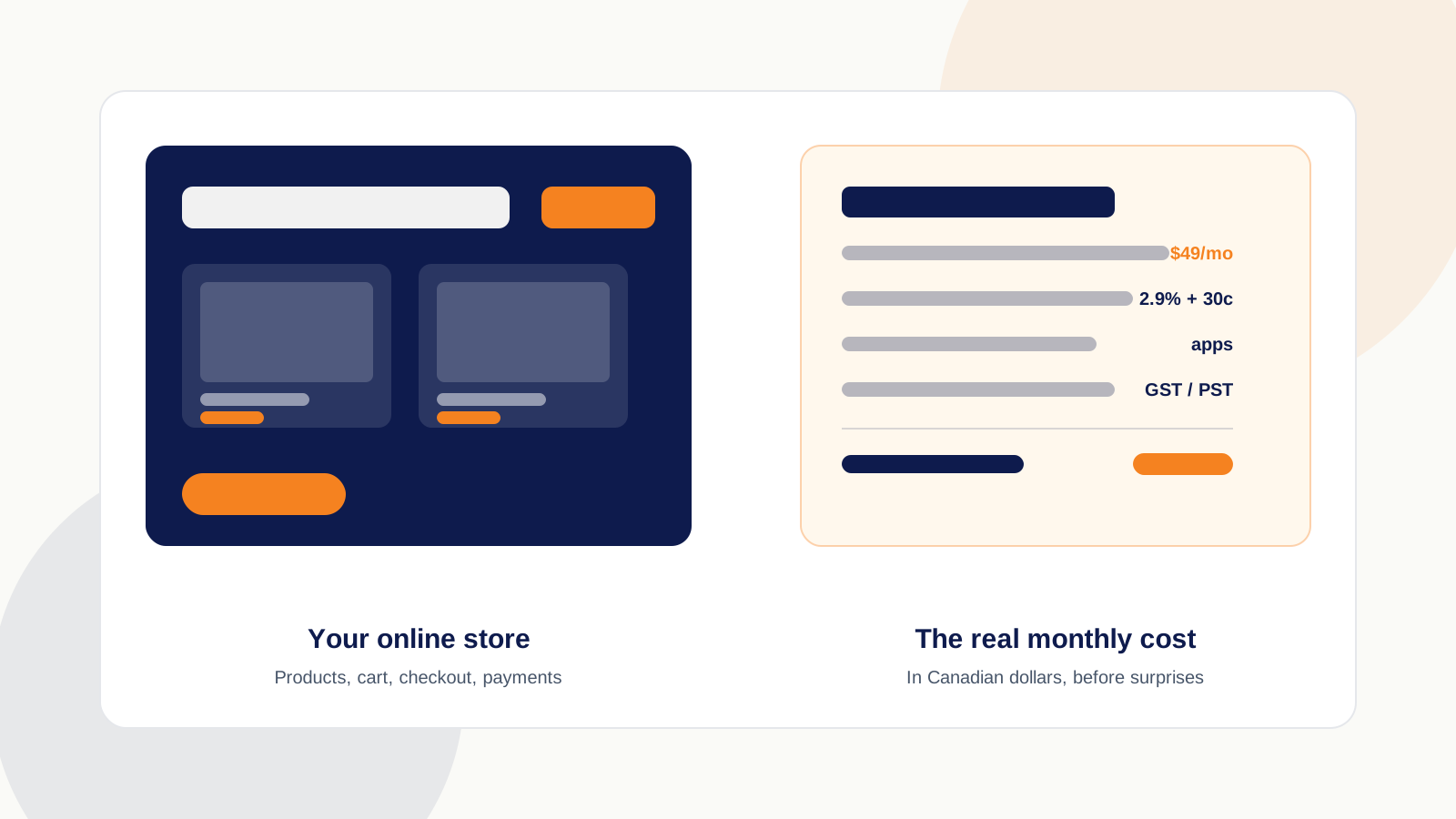
Here is the honest headline: for most Abbotsford small businesses, the website build is the small, easy cost. The platform fees, the payment processing, the apps, and the upkeep are what actually add up. This guide walks through all of it in Canadian dollars, plus the BC tax rules the generic guides skip.
How much does an ecommerce website cost in Abbotsford?
A lean online store for an Abbotsford small business costs about $500 to $2,000 CAD to set up in the first month, then roughly $150 to $600 CAD a month to run. The setup covers design and product loading. The monthly cost covers the platform, apps, and payment fees.
On the platform side, the numbers are clear. Shopify bundles hosting, checkout, and security into one monthly fee. As of this writing, Shopify's Canadian plans run about $49 CAD a month for Basic ($37 on annual billing), $99 a month for Grow on annual billing, and $389 a month for Advanced on annual billing. Our own web design packages, if you want it built for you, start at $500.
That is the ecommerce website design cost most people can see. The part they miss is that the sticker price of the plan is not the real monthly number. Apps, payment fees, and a bit of your own time all stack on top — which is the next section.
| Cost item | Typical range (CAD) | How often |
|---|---|---|
| Store setup + design | $500–$2,000 | One-time |
| Shopify plan (Basic) | ~$49 ($37 annual) | Per month |
| Apps / add-ons | $0–$150+ | Per month |
| Payment processing | ~2.9% + $0.30 per sale | Per transaction |
| Domain | ~$12–20 | Per year |
What are the hidden costs most owners don't expect?
The hidden costs of an online store are payment processing fees, paid apps, and tax setup — and in BC, provincial sales tax that can start far sooner than owners expect. These are the costs that turn a $49 plan into a much bigger monthly number.
Payment processing is the big one. Shopify Payments charges about 2.9% + $0.30 CAD on a standard online sale. If you use an outside payment gateway instead, Shopify adds a 2% fee on top on the Basic plan. International cards cost more again. One Canadian seller doing mostly overseas orders found their effective fee near 5% — enough to make or break a low-margin store. As one owner put it, "before you know it, your $60 CAD monthly fee becomes much more."
Then there is tax, and BC is where the generic guides fall down. Federally, you must register for GST/HST once your sales pass $30,000, per the CRA small-supplier rule. But BC PST is separate and can apply much sooner. A BC business selling taxable goods usually has to register for PST. A narrow small-seller exemption can apply to some home-based sellers, but only until their retail sales pass $10,000. Getting this right early saves a nasty surprise later.
From our projects
When we set up Scholars Hub on Shopify, the design was the quick part. The real work was loading 200+ products into the right collections, then configuring the store pages — search, contact, and every policy page: privacy, refund, shipping, and terms. That policy and payment setup is the part first-time owners never budget time for, and it is where a store goes wrong if it is skipped.
Shopify or WooCommerce — which is right for your business?
Choose Shopify if you want an all-in-one hosted store with predictable monthly costs and no maintenance to manage. Choose WooCommerce if you want lower core costs and more control, and you can handle the hosting, plugins, and updates. For many first stores, Shopify is the simpler, safer pick.
The honest comparison behind the shopify vs woocommerce question is about who does the upkeep. Shopify runs the plumbing for you — hosting, security, checkout, backups. WooCommerce is a free plugin on WordPress, so the core costs nothing, but you assemble and maintain the stack yourself, and premium plugins commonly run $500 to $1,500 CAD a year in renewals. If your catalogue is large or you want a managed store, Shopify usually wins. If you are budget-tight and comfortable managing WordPress, WooCommerce fits — and we cover that path in our guide to WordPress web design in Abbotsford.
There is also a simpler tier people forget. If your business mostly needs a small catalogue, local pickup, and easy checkout, a builder like Square Online or Squarespace can be enough — no need for a full ecommerce platform at all. The right shopify website design is the one that matches how big your store actually is.
| Platform | Best fit | Main trade-off |
|---|---|---|
| Shopify | Managed all-in-one store, larger catalogue, fast launch | Monthly fee + transaction fees on outside gateways |
| WooCommerce | Lower core cost, full control, WordPress-comfortable owner | You manage hosting, plugins, and updates |
| Simple builder (Square, Squarespace) | Small catalogue, local pickup, tight budget | Limited room to grow into a bigger store |
Do you even need a full online store yet?
Not always. If you have not proven that people will buy your product, a full online store can be the wrong first spend. Many owners do better validating demand on a marketplace or a simple page first, then building the real store once sales are real.
This is the advice the community gives that most cost guides skip. On Reddit and small-business forums, experienced sellers keep telling newcomers the same thing: do not overbuild too early. Test the offer on Amazon, Etsy, or a one-page checkout before you pour money into a polished custom store. One owner summed up the trap perfectly — "I'm spending 90% of my time tweaking my store instead of selling."
I tell Abbotsford clients the same thing, because it is the honest call. The website is the easy expense that opens the door to the harder ones: ads, shipping, and the time to run it all. If a lean store or a test page proves demand first, the money you later spend on a real ecommerce build is money spent on something you know works.
How does SEO work on an ecommerce store?
Ecommerce SEO comes down to three things: clear product descriptions, proper meta titles and descriptions, and well-organised collection pages. Each product and category page is a chance to rank for what people search. Most stores leave that value on the table with thin, copied product text.
On a product page, the description should answer real buyer questions, not just repeat the manufacturer's blurb. The meta title and meta description are what show in Google, so they need the product's real search term and a reason to click. Collection pages — your categories — are often your strongest ranking pages, because they target the broader term a shopper types before they know the exact product.
There is a lot more to it than the three basics, including the ways the platform can undo your work after you have done it. The full version is in ecommerce SEO on Shopify: what breaks while you optimise.
This is exactly why we do not just build a store and walk away. A store with 200 products has 200 product pages and a dozen collection pages, and every one needs real, search-ready content. Which leads to the part almost no ecommerce guide covers: who keeps all of that updated after launch.
Who keeps your store updated after launch?
The biggest ongoing cost of an online store is not the platform — it is keeping the product content, images, and inventory current. On a store with hundreds of products, that used to mean hours of manual work in the admin. We have changed how we do it, and it is the real difference in how we run ecommerce.
We now connect a client's Shopify store directly to our tools through a live connection that lets us manage the whole store from one place. From there we can add and update products, rewrite descriptions, refresh images, set meta titles and meta descriptions, and keep inventory current — all written to SEO standards, all without the slow manual admin work. The repetitive catalogue work is handled, so the store stays accurate and search-ready instead of going stale a month after launch.
That is the honest reason we can keep a large store maintained without a big monthly bill. The system does the repetitive part; a real person still reviews every change. It is the same way we run our SEO and web design work — build it right, then keep it right. If you want to see the kind of store we build and run, look at our Scholars Hub case study, or our full web design in Abbotsford service.
Two real tools worth knowing as you plan: Shopify for a managed store, and WooCommerce for a self-managed one. Open both pricing pages and the difference is clear: Shopify shows one monthly number, WooCommerce shows a free plugin and leaves the rest to you. Neither is wrong — they just suit different owners.
Frequently asked questions about ecommerce web design
How much does it cost to start an ecommerce site in Canada?
A lean Canadian online store usually costs about $500 to $2,000 CAD to set up, then roughly $150 to $600 CAD a month once you count the platform, apps, and payment fees. The build is the small part. Ongoing costs and payment processing are what add up over the first year.
Is Shopify still worth it in 2026?
For most small businesses, yes. Shopify bundles hosting, security, checkout, and payments into one predictable monthly fee starting around $49 CAD, so you are not stitching a stack together. It is worth it when you want to launch fast and not manage the plumbing. If your needs are very simple, a cheaper builder may do the job.
What is the cheapest way to build an ecommerce website?
The cheapest path is a simple builder like Square Online or Squarespace, or WooCommerce if you can manage the hosting and plugins yourself. WooCommerce core is free, but you pay for hosting and add-ons. Cheapest upfront is not always cheapest overall once your time and maintenance are counted.
Who is Shopify's biggest competitor?
WooCommerce is Shopify's biggest competitor for small businesses. WooCommerce runs on WordPress and gives you more control for a lower core cost, while Shopify gives you an all-in-one hosted platform. BigCommerce, Wix, and Squarespace also compete, mostly on the simpler end.
Are ecommerce websites profitable for small businesses?
They can be, but the website is rarely the biggest cost. Owners consistently say advertising, shipping, and payment fees affect profit more than the build. A store becomes profitable when the product margin covers those ongoing costs. That is why we push clients to keep the launch lean and prove demand first.
Do you build WooCommerce stores or only Shopify?
We build both, and we pick the platform to fit the business. We run Scholars Hub, a live 200-plus product store, on Shopify because that scale suits it. For a smaller catalogue or a tighter budget, WooCommerce or a simple builder can be the smarter call. The platform should fit you, not the other way around.

Harman Chahal
Thinking about an online store?
Send me what you want to sell and roughly how many products. I'll tell you honestly whether Shopify, WooCommerce, or a simpler builder fits — and what it will really cost you per month in Canadian dollars. No pressure, no quote-on-request mystery.