

Quick answer: AI SEO agents are AI helpers that each do one SEO job. One does keyword research, one writes a page and one checks it.
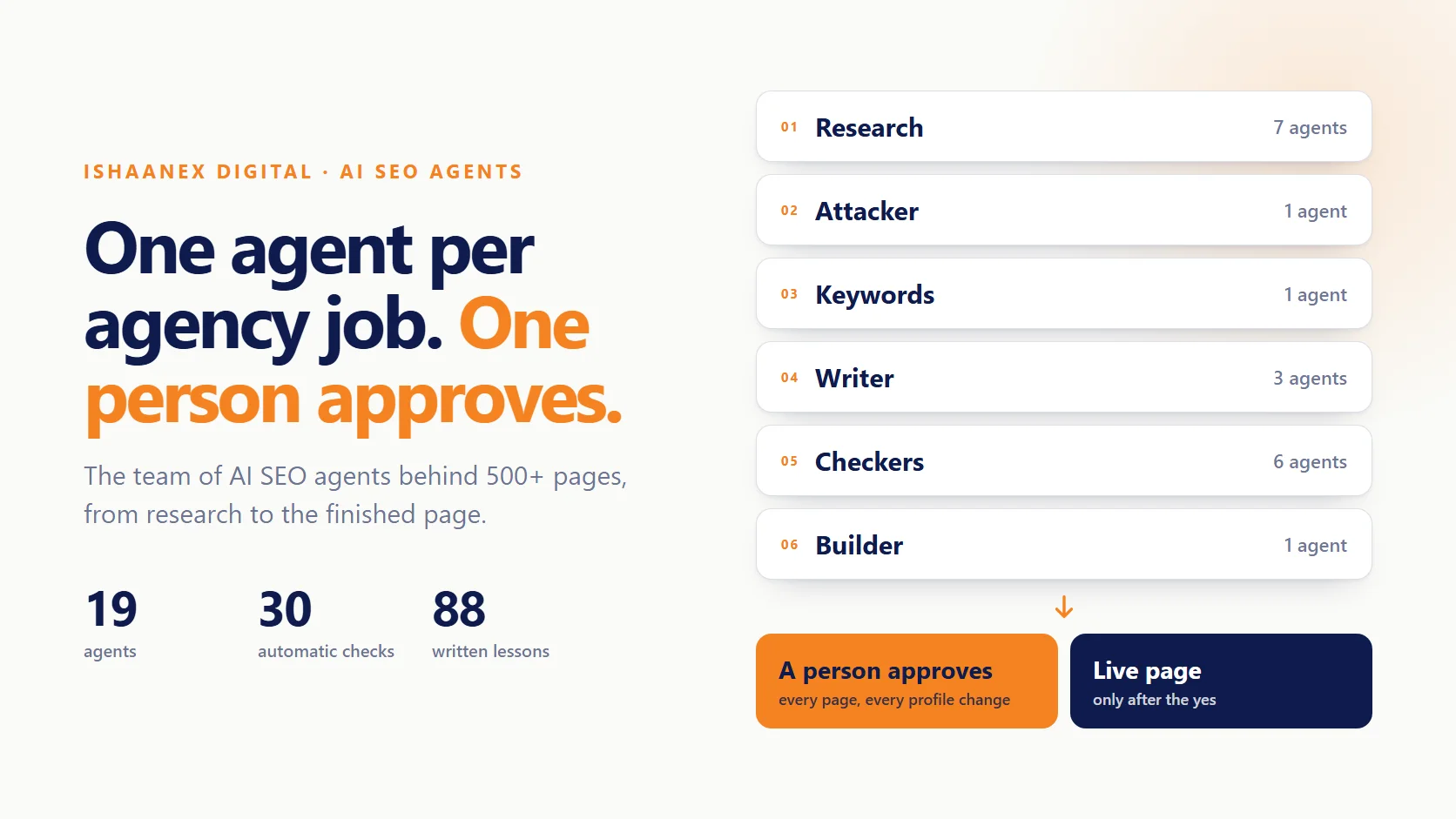
We built a team of them, one agent per job a large SEO agency would hire for. That team has produced more than 500 pages across many websites. A person approves every page before it goes live.
Quick summary
- 500+ pages built across many websites by the same team of AI SEO agents. Most have their own research folder.
- 5 steps to build one. List the jobs and write a guide for each. Turn guides into skills, skills into agents, then connect them.
- 0 pages go live without a person reading and approving them first.
- 30 automatic checks run on every build, before a person reviews the page. They catch everything from broken links to missing keywords.
- 25 to 30 real searcher questions are mapped for every new page before a word is written.
- 12.2% of Canadian businesses used AI to deliver their work in the year to mid-2025. That is double the year before (Statistics Canada).
Search “ai seo agents” and most of page one is a company selling its own agent. The top result in Canada is different. It is a Reddit thread asking if these agents actually work.
That is a fair question. We run an SEO agency in Abbotsford, BC, and our work runs on a team of AI agents.
This post shows how we built it, what it does, where it fails and where a person steps in.
What are AI SEO agents?
AI SEO agents are AI programs that take an SEO task and work through it step by step. They choose their own next move, use tools like a search engine or your analytics, and hand back finished work. A good one does one job well, the way one employee would.
Anthropic, the company behind Claude, describes agents as systems where the AI model will “dynamically direct their own processes and tool usage” (Anthropic). In plain words, it decides how to get the job done.
So yes, there is AI that can do SEO work. But a single chatbot asked to “do my SEO” does not do much. The results come from several agents, each with a narrow job, checking each other’s work.
What is the difference between an AI agent, a chatbot and an agentic workflow?
A chatbot answers what you ask, then stops. An agent picks its own steps to reach a goal. An agentic workflow runs fixed stages in a set order, with an agent doing the thinking inside each stage.
Anthropic draws the same line. It calls workflows “systems where LLMs and tools are orchestrated through predefined code paths” (Anthropic). So the steps are set in advance.
LLM means large language model, the engine behind tools like ChatGPT, Claude and Gemini.
Our system is an agentic workflow. The order never changes: research, then keywords, then writing, then checks, then building. Inside each stage, an agent decides how to do its part.
Think of a chatbot as a smart friend you can text. An agent is a staff member with a job description. An agentic workflow is the whole team, with a manager who says who goes next.
What can an SEO AI agent actually do?
An SEO AI agent can study the top-ranking pages and pull real keyword data. It can write a draft, check it against rules and build the finished page. The table below shows the jobs in our system, what each agent checks, and where a person approves the work.
Swipe the table sideways to see every column.
| Agency job | The agent | What it checks | Where a person approves |
|---|---|---|---|
| Research | Search results researcher | The top pages for the keyword, section by section | Before any writing starts |
| Research check | Research attacker | Weak, old or unsourced findings, which it throws out | Reviewed in the research summary |
| Keywords | Keyword mapper | Real search volume from keyword data, not guesses | The keyword plan, before writing |
| Writing | Content writer | Every searcher question has a section that answers it | The outline, before the full draft |
| Checking | Section auditor, quality grader, reader pass | Missing answers, AI-sounding lines, confusing headings | The scored draft |
| Building | Page builder | Links, schema, keywords and 30 automatic checks | The final page, before it goes live |
| Google Business Profile | Profile agent | Descriptions, posts and categories | Every change, before it is saved |
Each agent in Claude Code runs as a subagent. The docs explain that “each subagent runs in its own context window with a custom system prompt, specific tool access, and independent permissions” (Claude Code docs). So each agent works alone, with its own instructions.
That is why the checker never shares a brain with the writer.
Tool companies show the same kind of work. At Ahrefs, one staff member’s agent fixed a broken image, then opened a code change for review (Ahrefs). The pattern is the same: the agent does the work, a person approves it.
Do AI SEO agents actually work? What the AI summary misses
Yes, they work, but not the way most tools sell them. Google’s AI summary for this search (checked September 2026) says an SEO agent works “without constant human input.” In our experience, agents do the work well, but a person still has to decide what goes live.
The people who have tried these tools say the same thing. One founder tested ten agentic SEO tools on 60 live sites. Their verdict: “Six produced beautiful plans and touched nothing” (Indie Hackers).
Another tool in the same test made changes they had to undo after three articles lost rankings (Indie Hackers).
An n8n forum user asked the question most sellers skip: “How much manual review is still required before publishing?” (n8n Community). Nobody in the thread answered it.
A person reads every page. The agents work around the clock, and publishing waits for a human yes.
Two problems keep turning up:
- Pages that never get indexed. One team found that AI pages with generic questions “sat in ‘discovered, currently not indexed’ limbo” (Indie Hackers). Volume without real answers gets ignored.
- Setups that break when the AI model changes. A forum user asked how stable a setup stays “with all the recent OpenAI model updates” (n8n Community). Ours holds because the rules live in saved files that every agent reads.
How do you build an AI agent for SEO? Start with the agency, not the tool
To build an AI agent for SEO, start with the jobs, not the software. List every role a large SEO agency would hire for, and write a guide for each one. Turn each guide into a skill, turn each skill into an agent, then connect the agents in a fixed order.
That is how we did it. Our first question was how you would run an SEO agency on autopilot, and what its parts would be. The second, in Harman’s words: “Say this is a big SEO agency. How many employees would it have?”
This is the order we followed. It is our answer to how to build an AI agent that does real SEO work.
- List the jobs. Researcher, keyword planner, writer, editor, fact checker, page builder, profile manager. Write them down before any code.
- Write a guide for each job. Base it on your own research and your own client work. We learned SEO from the ground up, and every lesson became a reference file.
- Turn each guide into a skill. A skill is a saved set of instructions the AI loads when that job comes up. In Claude Code, you “create a SKILL.md file with instructions, and Claude adds it to its toolkit” (Claude Code docs).
- Make each skill an agent. Give it one job, its own tools and a clear list of what it may not touch.
- Connect the agents. Set the order, and add an agent whose only job is to attack the work of the others.
Our page-building team has six branches, with 19 agents working inside them:
- Research: reads the top-ranking pages section by section and takes screenshots. It checks how easy each page is for AI to quote, and collects real questions from forums.
- Attacker: tries to break the research before anyone writes. Weak or unsourced findings get thrown out.
- Keywords: combines three keyword sources and checks each one against real search data.
- Writer: drafts the page from the approved plan and the business’s own expertise.
- Checkers: a section auditor, an independent grader, a reviser and a reader pass. The grader never grades its own work.
- Builder: turns the approved copy into the live page and runs 30 automatic checks.
One rule makes the system better over time. When an agent makes a mistake, we write it down as a lesson the agents read next time. Our page-building agents now read 88 of those lessons.
We cover the Claude Code side in more depth in our guide to Claude Code agents for SEO pages.
How does one page answer the searcher’s whole journey?
Before any page is written, the agents list every question the searcher has around that topic. Then each question is tied to the section of the page that answers it. A reader should never have to go back to Google to finish the job.
This is where our system differs from pages built just to fill a keyword. We start with search intent, meaning what the person really wants when they type that phrase.
Then we map the questions around it. That means the “what is it”, the price, the trust worries, the process and the other options.
Google’s own checklist asks: “will someone leave feeling they’ve learned enough about a topic to help achieve their goal?” (Google Search Central).
A real example comes from our own site. The question map for our AI agent development page holds 25 questions in eight groups. Here are six of them:
| Question group | Example question from the real map |
|---|---|
| What it is | What is the difference between an AI agent and a chatbot? |
| Price | How much does a custom AI agent cost? |
| Trust | How do I know the agent will not make unsafe decisions? |
| Process | How is the agent tested before launch? |
| Options | Is n8n enough, or do I need custom code? |
| Uses | Can an AI agent qualify leads? |
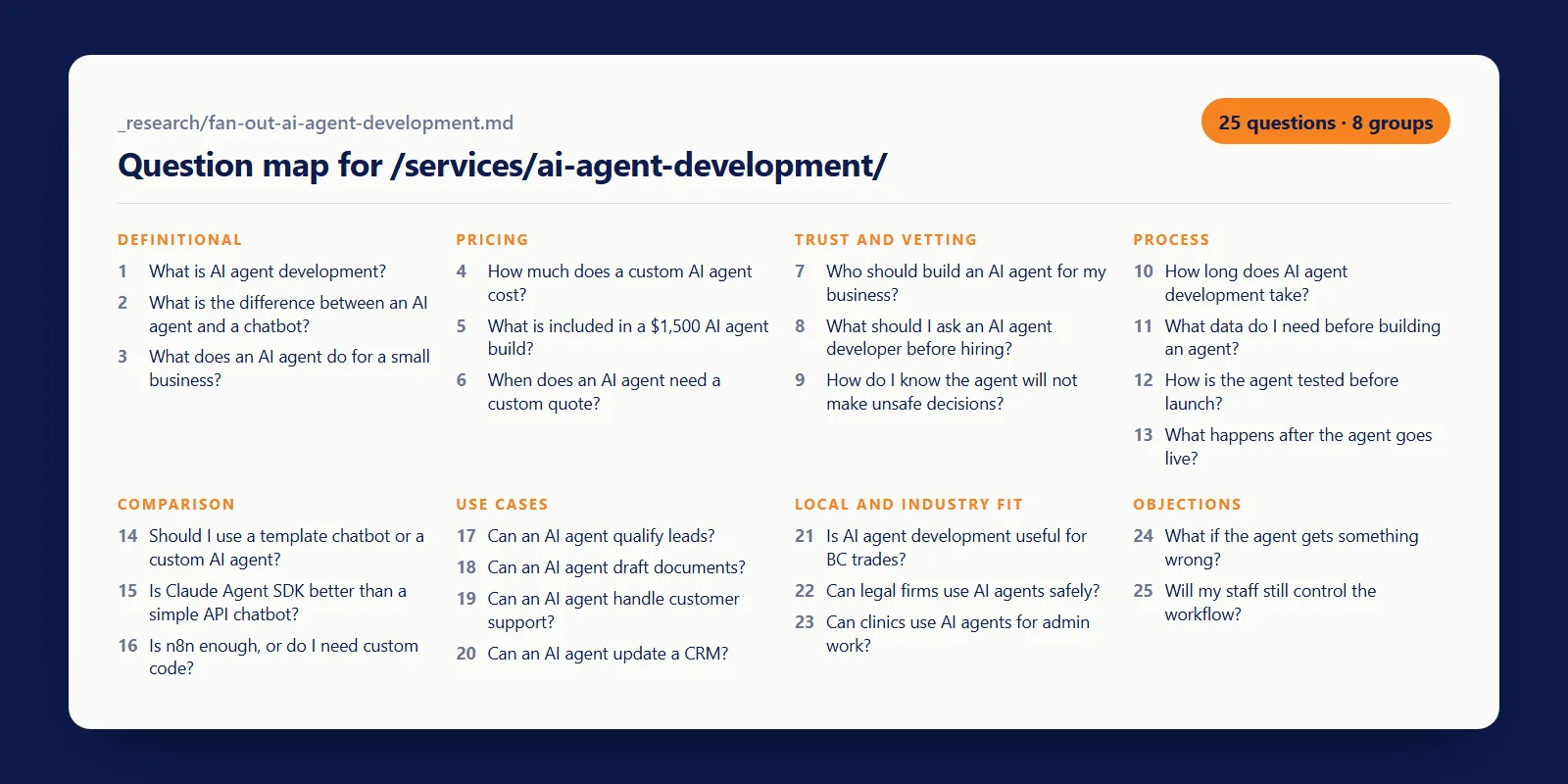
Our research folders hold 22 saved maps like this one. We have now added a separate checker agent to go with them.
Its only job is to confirm each question is actually answered on the finished page. It checks what each answer means rather than matching words, and it is never the agent that wrote the page.
Google asks site owners a version of this question in its own guidance. It warns that AI pages made “without adding value for users” can break its spam rules (Google Search Central). Mapping the whole journey is how we put the value in on purpose.
It is also how the AI agent development page was planned.
Where does a person still approve the work?
A person approves every page before it goes live, and every change to a Google Business Profile. The agents prepare and score the work, but publishing is a human decision every time. Our guardrails come from real mistakes, written down so they never repeat.
One mistake shaped our profile agent. On May 17, 2026, we switched on “show business address” on our own Google Business Profile by accident. We switched it off, but it was too late.
Google forced a fresh verification and blocked posting for up to five days while it checked.
To get the profile back, we had to record a video. It showed the street sign, the building, the workspace and the website on screen.
So the profile agent has a hard rule. It never touches the address, the address setting or any field that can trigger a new verification. It also never stacks several big changes at once, because a person makes those calls.
Three more places a person stays in charge:
- The research summary. A person reads the facts and sources and can cut any of them.
- The outline. No full draft is written until the plan is approved.
- The claims. Any number or result about a business must be on an approved list, or a build check stops the page.
For the small-business view, read our post on SEO automation with AI agents for small business. It covers where human review matters most.
Want this process on your own site? We build the pages and you approve each one before it goes live. Book a free call and we will walk you through it.
Does Google penalise pages built with AI agents?
No, Google does not penalise a page for using AI. It penalises pages made to game rankings instead of helping people. Its spam policy calls it scaled content abuse when “many pages are generated for the primary purpose of manipulating search rankings and not helping users” (Google spam policies).
Google is clear that the method matters less than the result. Its guidance says to “focus on accuracy, quality, and relevance, especially when automatically generating the content” (Google Search Central). That includes page titles, meta descriptions, schema (code that describes a page to search engines) and image alt text.
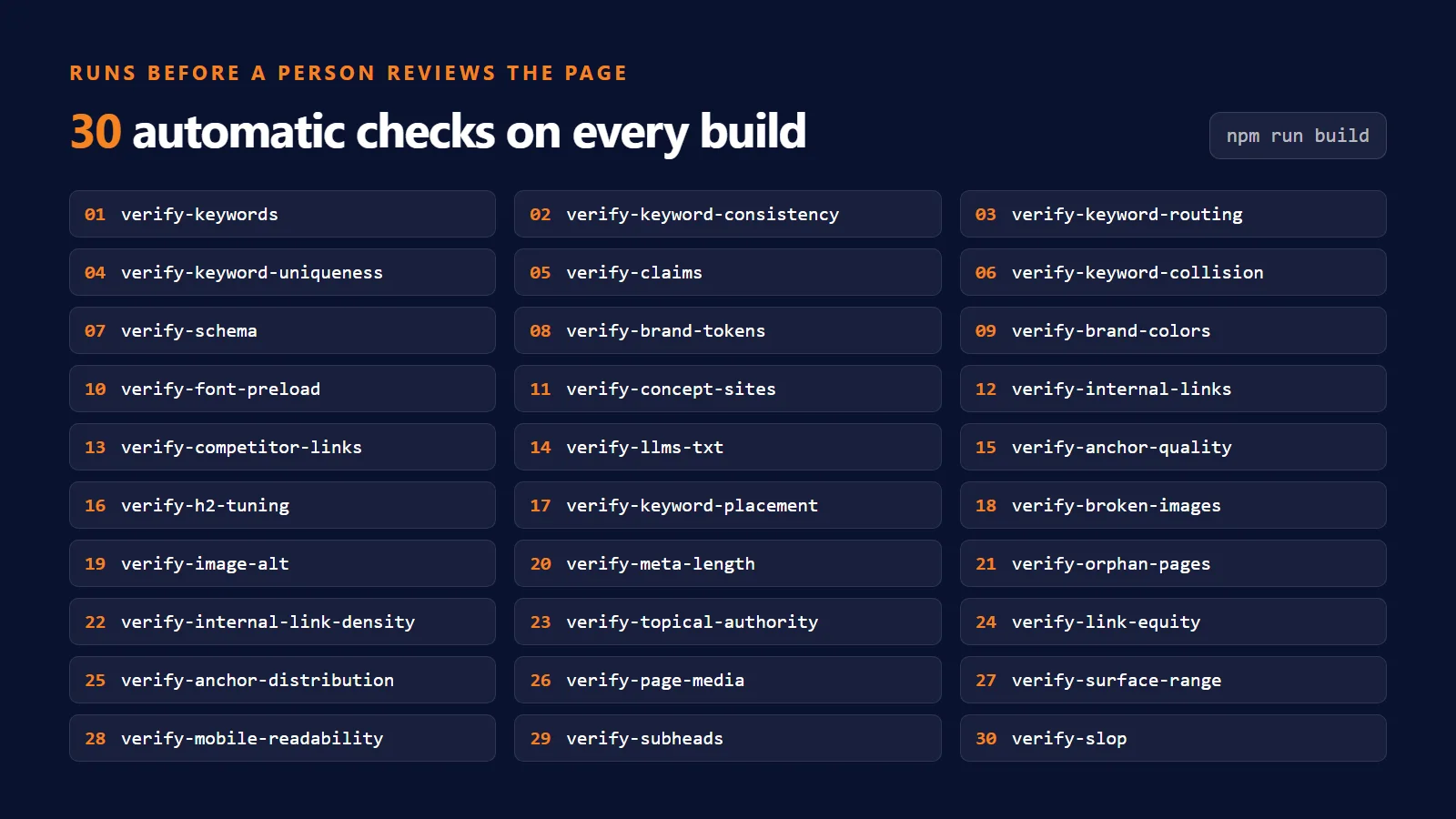
Our 30 automatic checks put that advice into practice. They catch a missing keyword or a broken link. They also catch a title that runs too long, or a claim with no approval behind it.
Google also asks this: “Is the use of automation, including AI-generation, self-evident to visitors through disclosures or in other ways?” (Google Search Central). That is one reason we are writing this post in the open.
Which tools do you need to build or buy an SEO agent?
To build your own, you need an AI model, a link to your data and a place to save instructions. To buy one, SEO tool companies now sell ready-made agents.
Building costs more time up front. Buying costs less time, but the agent knows nothing about your business.
Most SEO agents run on one of three AI models: ChatGPT by OpenAI, Claude by Anthropic or Gemini by Google. We build on Claude Code, because its skills and subagents map neatly onto agency jobs.
MCP, short for Model Context Protocol, ties it all together. Its own site calls it “an open-source standard for connecting AI applications to external systems.” It also says it works “like a USB-C port for AI applications” (Model Context Protocol).
MCP lets an agent read your keyword data, your analytics or your site files. Our MCP servers for SEO guide lists the ones we use.
Your main options look like this:
Swipe the table sideways to see every column.
| Option | Examples | Best for |
|---|---|---|
| Build with code | Claude Code, the Claude Agent SDK | Agencies that want their own method built in |
| Build without code | n8n, Make, Zapier, Gumloop | Simple, repeatable tasks like reports |
| Buy a ready agent | Frase, Surfer, Ahrefs, Semrush agents | Teams that want a result this week |
Which AI agent is best for SEO? The one that knows your process.
A ready-made agent follows the vendor’s idea of SEO. A built one follows yours.
Is SEO still worth it in 2026 with AI agents and AI Overviews?
Yes, but the bar is higher. AI summaries now answer simple questions right on Google, so thin pages lose clicks. Pages that answer the whole journey and show proof still win.
Google counts traffic from AI Overviews and AI Mode in Search Console, so you can measure it (Google Search Central).
The drop in clicks is real. Pew Research tracked real searches, and people clicked a result on 8% of visits when an AI summary showed up. Without one, they clicked on 15% of visits (Pew Research Center).
That is why agentic SEO matters more now. The pages that still earn clicks are the complete ones.
By hand, one detailed page used to take us two full days. With the agents, it takes about an hour, and the research and checks still happen.
Most Canadian businesses have not started yet. In the third quarter of 2025, 66.7% had no plans to use AI in the next year (Statistics Canada).
Frequently asked questions
Is there an AI that can do SEO?
Yes. AI agents can research keywords, study competing pages, write drafts and check pages against SEO rules.
What they cannot do alone is decide what should go live. The best results come from a team of agents plus a person who approves the final work.
Who are the big 4 AI agents?
There is no official list. Most agents are built on ChatGPT by OpenAI, Claude by Anthropic or Gemini by Google.
Microsoft Copilot is often named as a fourth. The model matters less than the instructions, tools and checks you give it.
Is it possible to build my own AI agent?
Yes. Write down the job the agent will do, then write a clear guide for that job. Tools like Claude Code turn that guide into a skill and then an agent.
No-code tools like n8n work for simpler tasks.
Can agentic SEO work for a local business?
Yes. Local pages need real research, real questions from customers and local detail. Agents make that practical for every service and city.
The local facts still need to come from the business itself.
How long does it take to build an SEO agent system?
A single agent for one task can be set up in a day. A full team that covers research, writing, checking and building takes months of testing. Ours grew one lesson at a time, with 88 mistakes turned into written rules so far.
Will AI agents replace SEO agencies?
No. Agents replace the slow, repeated parts of the work. Someone still needs to know SEO and approve what goes live.
Agencies that build agents around their own method will do more work with fewer mistakes.
Want AI SEO agents working on your site?
We build and run AI SEO agents for local businesses in Abbotsford, the Fraser Valley and across Canada. More than 500 pages across many websites have gone through this system, and a person approved every one before it went live.
Want an agent built around your own business? See our AI agent development service, or send us a message and we will tell you honestly whether an agent fits.