

What is a Skill in Claude Code?
A Skill is a reusable instruction set. In plain English, it is a checklist that Claude can load when the task needs a known process.
Anthropic's Claude Code documentation says Skills are useful when you keep pasting the same instructions or when a section of a project instruction file has grown into a procedure. That is exactly how I use them: if the work needs the same steps every time, it should probably become a Skill.
In my SEO work, Skills are best for repeatable tasks:
- backlink prospecting
- competitor audit steps
- People Also Ask research
- blog post writing
- human-voice cleanup
- final quality checks
A Skill does not need to invent the process each time. It follows the process I already trust.
That is why I think of Skills as the checklist layer.
They are not useless. They are just not the same thing as a Sub-Agent. A Skill is better when consistency matters more than independent judgement.
What is a Sub-Agent?
A Sub-Agent is a separate worker with its own context. Anthropic describes subagents as specialised assistants that handle specific tasks in their own context window and return the result back to the main session.
That separate context is the part most beginners miss.
If I ask the main session to research competitors, read five pages, pull keyword ideas, and compare sections, the main conversation gets crowded fast. A Sub-Agent can do that work separately, then report back with the useful summary.
That is why I use Sub-Agents for thinking tasks:
- keyword gap analysis
- competitor research
- local SEO strategy
- content planning
- internal link planning
- independent review
The simple rule is this:
| Work type | Better tool | Why |
|---|---|---|
| Same checklist every time | Skill | The steps are already known |
| Research or judgement | Sub-Agent | It needs separate thinking |
| Whole page build | Agent | It needs a coordinated team |
| Final trust check | Quality Harness | Builders should not grade their own work |
That table is the easiest way I explain it to myself.
How do Agents fit into the workflow?
An Agent is the coordinator. It can run a team of Sub-Agents underneath it and pull their work into one outcome.
My most-used example is my page-build agent. I use it when a new SEO page needs more than a simple draft. A good local SEO page is not just "write 1,500 words and add a few keywords." It needs research, proof, search intent, topical coverage, internal links, and a final check.
The build-page agent breaks that into parts:
- one Sub-Agent handles keyword research
- one studies competitor pages
- one maps topical coverage
- one plans internal links
- one writes the content
- one checks whether the target keywords actually landed
- one reviews the page against the standard
That is the difference between a one-prompt draft and a system.
A one-prompt draft can look good and still miss the keyword, ignore internal links, or make claims that are too vague. A coordinated agent can make each step visible.
What happened with the Abbotsford SEO page?
The cleanest proof is the Abbotsford page.
I built the Abbotsford digital marketing hub with my /build-page agent and connected it to the wider SEO Abbotsford cluster. By hand, a page that detailed would have taken me close to two full days. I would have had to research the keyword, check competitors, map sections, write the page, build internal links, and run the final checks myself.
With the agent, the build took about one hour.
The important part is not only the time saved. The important part is that the page ranked.
On 12 June 2026, the page appeared as the first organic result in the screenshot for seo company in abbotsford. The local pack sits above it, so the accurate claim is first organic result or page-one organic visibility, not "number one overall on every Google surface."
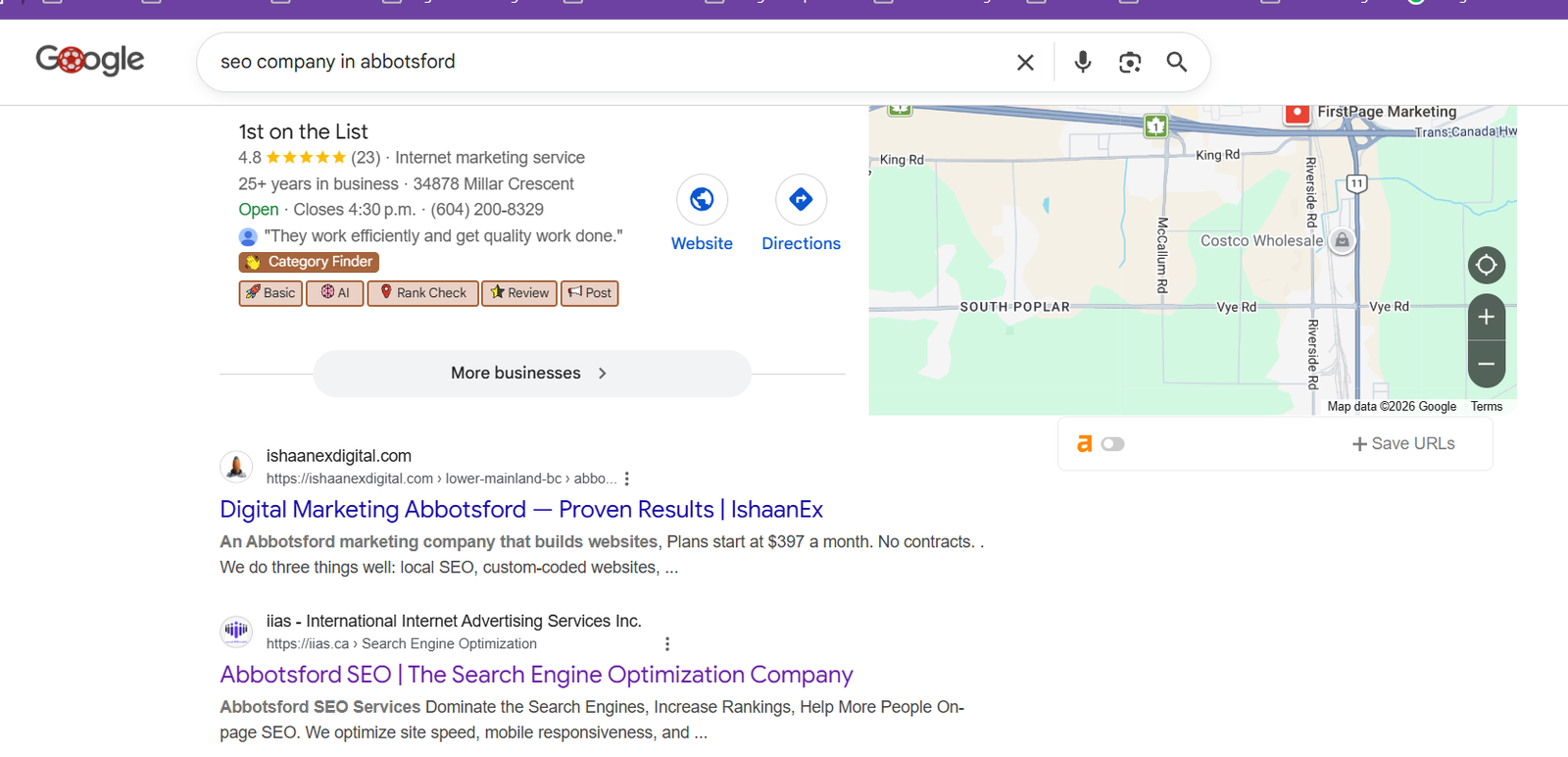
That distinction matters. I do not want proof language that sounds bigger than the evidence.
The page also appears in Google AI Mode for the same query. In the screenshot Harman supplied, IshaanEx Digital is listed in the AI Mode result and appears in the source panel.
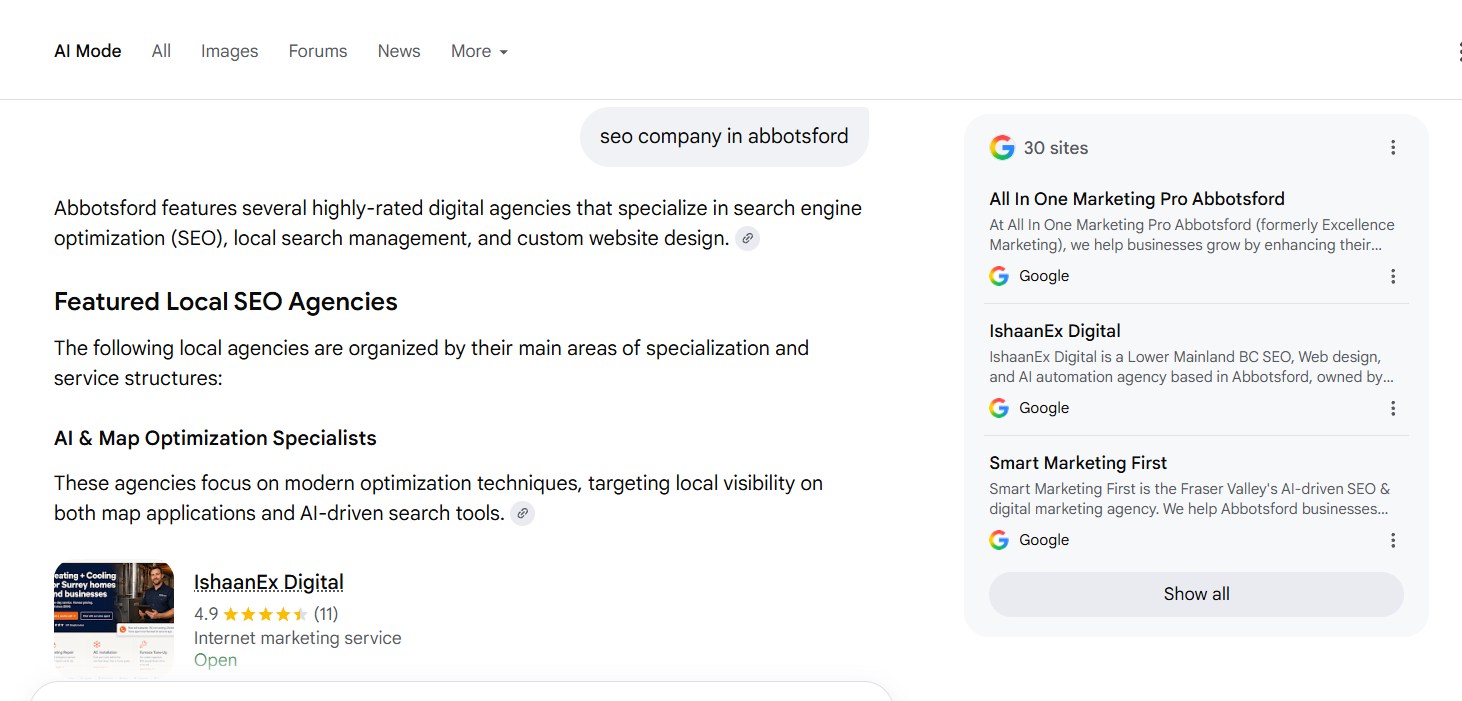
That is the type of proof I want on this blog: not "AI changed everything," but "here is the page, here is the query, here is what Google showed."
What happened with the AI automation page?
The AI automation Abbotsford page gives a second proof point.
For ai automation services abbotsford, the screenshot shows IshaanEx Digital cited in the AI-style answer block and visible as a page-one organic result. Again, the careful claim is page-one visibility and AI answer visibility, not a permanent rank promise.
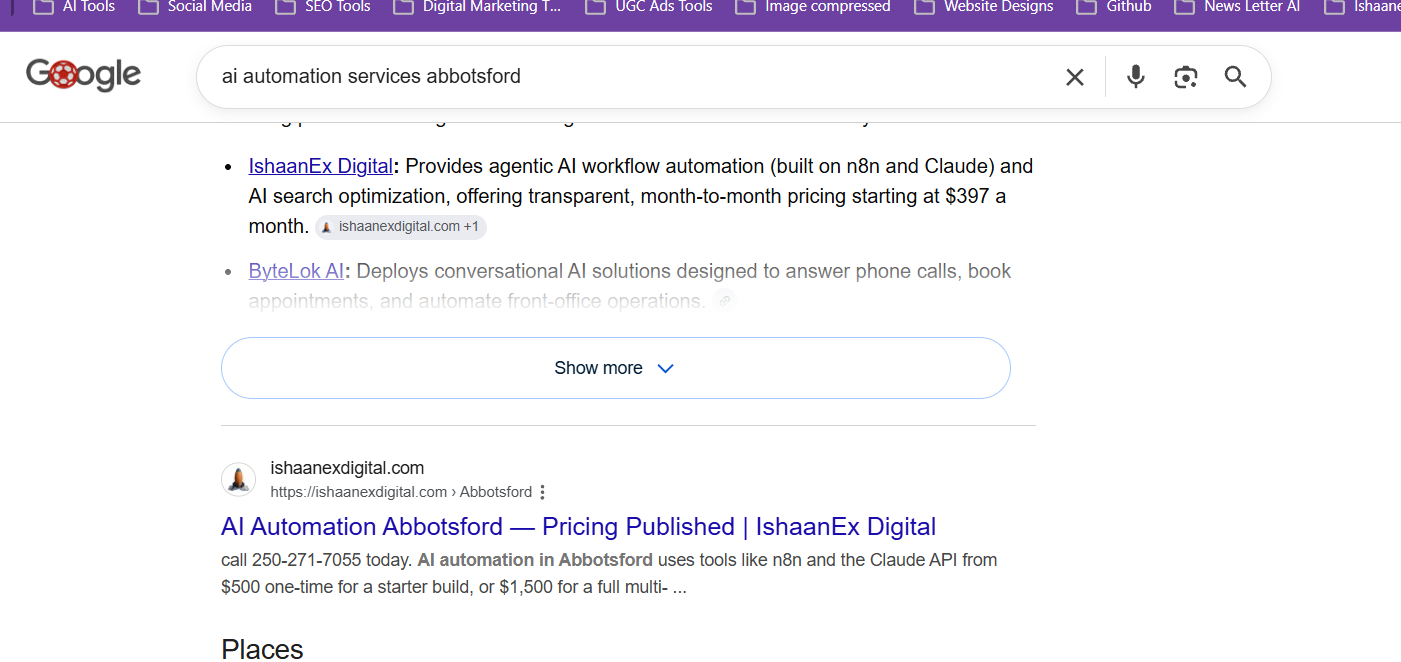
This matters for two reasons.
First, it shows that the system is not only producing old-style SEO pages. It is also creating pages that can be understood by AI search surfaces, which is why I treat AI search optimisation as part of the SEO build instead of a separate buzzword.
Second, it proves the workflow is working on IshaanEx Digital's own site. That is a stronger proof point than saying "we can do this for clients" without showing it in our own house.
What is the Quality Harness?
The Quality Harness is my anti-bias review loop.
The most common mistake with AI content is letting the same system that wrote the page also judge the page. That does not work well. The writer is attached to the output. It is too easy for it to say, "This is good," because it just built the thing.
So I separated the builders from the reviewers.
The process works like this:
- The building Sub-Agents finish the page.
- A separate review layer checks the page.
- The reviewers score it against the standard.
- If the score is too low, the page goes back for fixes.
- The revised version goes back to the reviewers.
- The loop runs until the content reaches the target score.
The key word is separate.
Independent review is what makes the score useful. If the same agent writes and reviews, the review is too soft. If a different agent reviews, the critique gets sharper.
This is the part of the system I trust most, because it handles the problem that makes AI dangerous for SEO: confident output that has not been checked.
What do the gates check?
The Quality Harness judges the writing. The gates check the mechanics.
Those are different jobs.
A page can read well and still fail SEO implementation. It can miss the exact keyword. It can use the wrong anchor text. It can forget to link to a service page. It can leave an internal link pointing to a page that is not live yet.
That is why I use gates.
The gates check things like:
- whether the primary keyword appears in the right places
- whether secondary keywords are covered
- whether the internal links exist
- whether anchor text matches the plan
- whether the page has enough body coverage for the search intent
- whether the page follows the project rules
Google's own generative AI search guidance still points back to the basics: useful content, clear structure, crawlability, page experience, and unique expert information. The gates are how I keep those basics from becoming optional.
They are not soft reminders. They are checkpoints.
Why keep a mistake log?
The mistake log is one of the most underrated parts of the system.
Every time an agent misses something, I log it. If it misses a keyword, that becomes a rule. If it forgets an internal link, that becomes a rule. If it uses weak proof language, that becomes a rule.
That is how the system gets sharper over time.
Before I had this setup, I was the checklist. I had to remember every lesson myself. That works until you are tired, rushed, or working across too many pages at once.
Now the lessons live in the system.
That does not remove my judgement. It protects my judgement from getting wasted on repeat mistakes.
What should stay human?
This is where I disagree with the lazy version of AI SEO.
AI should not be the final authority on strategy, proof, or voice.
It can prepare the work. It can check the work. It can make the next draft better. But the final call still needs a person who understands the client, the market, and the search intent.
For IshaanEx Digital, that means I still review:
- whether the page helps a real customer
- whether the claim is backed by proof
- whether the voice sounds like me
- whether the page should exist at all
- whether the CTA fits the reader's stage
- whether the ranking claim is honest
That last one matters. A screenshot can show page-one visibility, a first organic result, or an AI Mode citation. Those are not the same claim. The blog has to say the exact thing the proof supports.
Google's helpful content guidance asks whether content shows first-hand expertise and gives readers enough information to achieve their goal. That is a human review question, not only a keyword question.
How would I start if I were building this again?
I would not start by trying to build a giant agent.
I would start with the quality control layer.
Most people chase speed first. That is easy. You can get AI to produce words quickly today. The harder part is getting output you can trust.
My order would be:
- Write one Skill for a repeatable checklist.
- Add one Sub-Agent for independent research.
- Add one reviewer Sub-Agent that did not build the work.
- Add a simple scoring rubric.
- Add gates for the mechanical checks.
- Keep a mistake log.
- Only then build a larger Agent to coordinate the full workflow.
That order keeps the system grounded.
If you build the team first, you get speed without discipline. If you build the review layer first, you get a system that improves.
What does this mean for local businesses?
Most local business owners do not care about Claude Code agents, Skills, or Sub-Agents.
Fair enough.
What they care about is whether the work gets done properly. Does the page match what customers search? Does it explain the service clearly? Does it include proof? Does it connect to the rest of the site? Does it help the business get found?
That is the real value of this system.
At IshaanEx Digital, I use AI internally to make the work more consistent across SEO services, local pages, and AI automation services. The client does not need to buy the tool. The client needs the result: a clearer SEO page, stronger internal links, better proof, and fewer missed details.
That is also why I avoid leading with "AI does your SEO." That framing sounds low-effort. The better truth is this:
I built a system that helps me deliver better SEO work with more checks built in.
The AI is the tooling. The system is the offer.
Frequently asked questions about Claude Code agents for SEO
What are agents in Claude Code?
Claude Code agents are AI workers that can handle tasks with tool access, context, and instructions. In my SEO workflow, the main agent coordinates page-building work while Sub-Agents handle research, competitor checks, internal linking, writing, and review.
Do skills work in Claude Code?
Yes. Skills work in Claude Code as reusable instructions for repeatable tasks. I use them when the process is already known, such as blog writing, backlink prospecting, content checks, and human-voice cleanup.
How do you use subagents in Claude Code?
Use subagents in Claude Code when a task needs separate research, review, or strategy work. For SEO, I use them for competitor checks, keyword gaps, topical mapping, internal links, and independent review before I approve the page.
What is the difference between Claude Code subagents and Skills?
Claude Code Skills are checklists. Claude Code subagents are separate workers with their own context. I use Skills for repeatable execution and subagents for tasks that need independent thinking, research, or critique.
Are Claude Code skills worth it?
Claude Code Skills are worth it when you repeat the same process often. They save time, reduce skipped steps, and keep quality checks consistent. They are less useful for one-off strategy work that needs a fresh judgement call.
Can Claude Code be used as an agent for SEO?
Yes, Claude Code can be used as an agent for SEO workflows when it has a clear process, real keyword data, source-backed questions, and human approval. The strongest use is not blind publishing. It is research, checks, drafts, reviews, and gates.

Harman Chahal
Want the same review layer on your SEO pages?
If your SEO content feels scattered, start with the checks. IshaanEx Digital can review your service pages, location pages, internal links, and AI-search visibility, then show you what is missing before you spend money on more content.
We serve Abbotsford digital marketing clients, Surrey, Langley, Chilliwack, Vancouver, West Vancouver, and the Lower Mainland. Local SEO starts at $397/month, and AI automation in Abbotsford is available for workflow builds that need clearer process and follow-up.