A logo speaks before anything else on your business does. People do judge the book by its cover, so that first look is where trust starts or stalls.
So can ChatGPT make a logo? Yes. Tell it "this is my website, give me a logo" and you will have one before your coffee cools. What you probably won't have is something that speaks your brand's language.
We build websites for businesses in Abbotsford and across BC, and logos come up on those jobs. This post shows the difference using the real files from one logo job. That logo was also made with AI, so the real comparison here is one prompt against a process.
Can ChatGPT make a logo?
Yes. ChatGPT can make a logo in seconds, and it will draw whatever you describe. Add your business name, trade and colours, then ask again until you like one. For a side project or an idea you are still testing, that can be good enough.
The same goes if you ask "can ChatGPT design a logo?" It can produce the picture. Design is the part that comes before the picture: who it has to speak to, which competitors it sits beside, and where it has to work.
Treat any ChatGPT logo generator as a fast sketch tool. It's very good at that. Just don't put that first sketch straight on your front glass.
Why do ChatGPT logos look so alike?
ChatGPT logos can look alike, and the likely reason is that many people in one trade give the same system nearly the same request. OpenAI's terms of use warn that "output may not be unique and other users may receive similar output". Without time spent developing the idea, you get the same type of result.
I saw this in October. I was out and noticed a logo on a business's front glass. It looked almost identical to the logos of two of my own clients in the same industry.
One of those clients had told me outright it was made in ChatGPT. I don't know how the other two were made. All three looked the same, so nobody could tell the brands apart.
Research suggests something similar, though it didn't test logos. A 2025 study in Patterns ran 700 image-generation loops of 100 rounds each, and they ended at "just 12 dominant motifs". Its authors called this "visual elevator music". Those were lab experiments on other image models, not ChatGPT, so treat it as a clue.
What does a lookalike logo cost your business?
A lookalike logo makes your business harder to tell apart, and that is the one job a logo has. Canada's trademark office defines a trademark as a sign that distinguishes your goods or services from everyone else's. It also warns that people who can't pick you out may go to someone easier to notice.
Picture a customer who was happy with you last spring. They search your trade, and three similar logos show up on the map. They now have to read names to find you, and some won't bother.
Here is what I tell clients when this comes up:
"I'm not asking you to pay me just because I can design a logo. The logo is what goes on your business card and makes you stand out from competitors. If everyone uses the same system to design their logo, they are all going to look the same, and your clients will be confused."
The money is rarely the first problem with a cheap logo. Customers doubt it first, and then you pay to redo it on your truck, your signs and your custom website design.
What does one prompt skip?
One prompt skips almost everything before the drawing and after it, from the written brief to the file set. Here is what ChatGPT logo design usually leaves out when you stop at the first image. You can ask ChatGPT to help with some of these steps. Do them whichever tool you use.
| Step | One prompt, stopped at the first image | A real process |
|---|---|---|
| Brief | A sentence or a URL | Written pass-or-fail tests before any drawing |
| The business's own language | Whatever it can infer | Read and sorted first |
| Competitors | Not looked at | Real logos in the category, tallied |
| Small sizes | Not checked | Tested at profile-picture size first |
| Options | Variations on one idea | Different starting ideas, drawn in black |
| Real use | A sample picture | Placed in a website header |
| Someone looking for faults | No one | A fresh AI reviewer told to find them |
| Files | A PNG, usually | Clean outlines plus a labelled file set |
| Trademark | Not checked | Flagged for a search before you commit |
What does a real logo process look like?
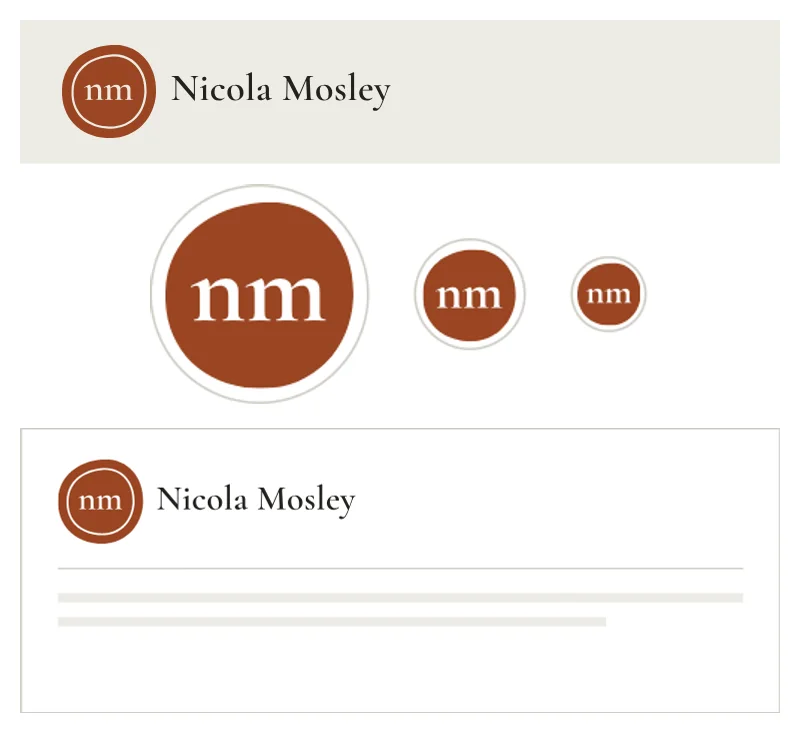
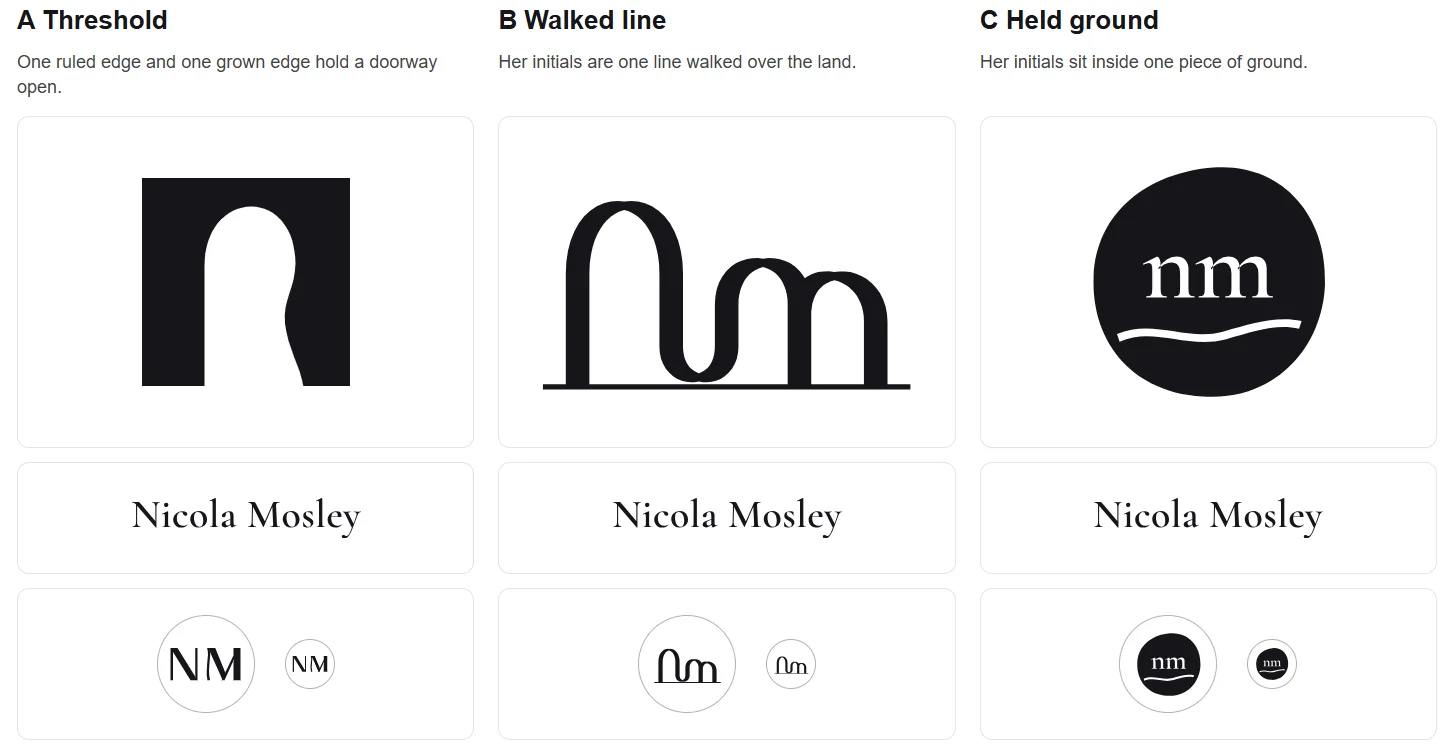
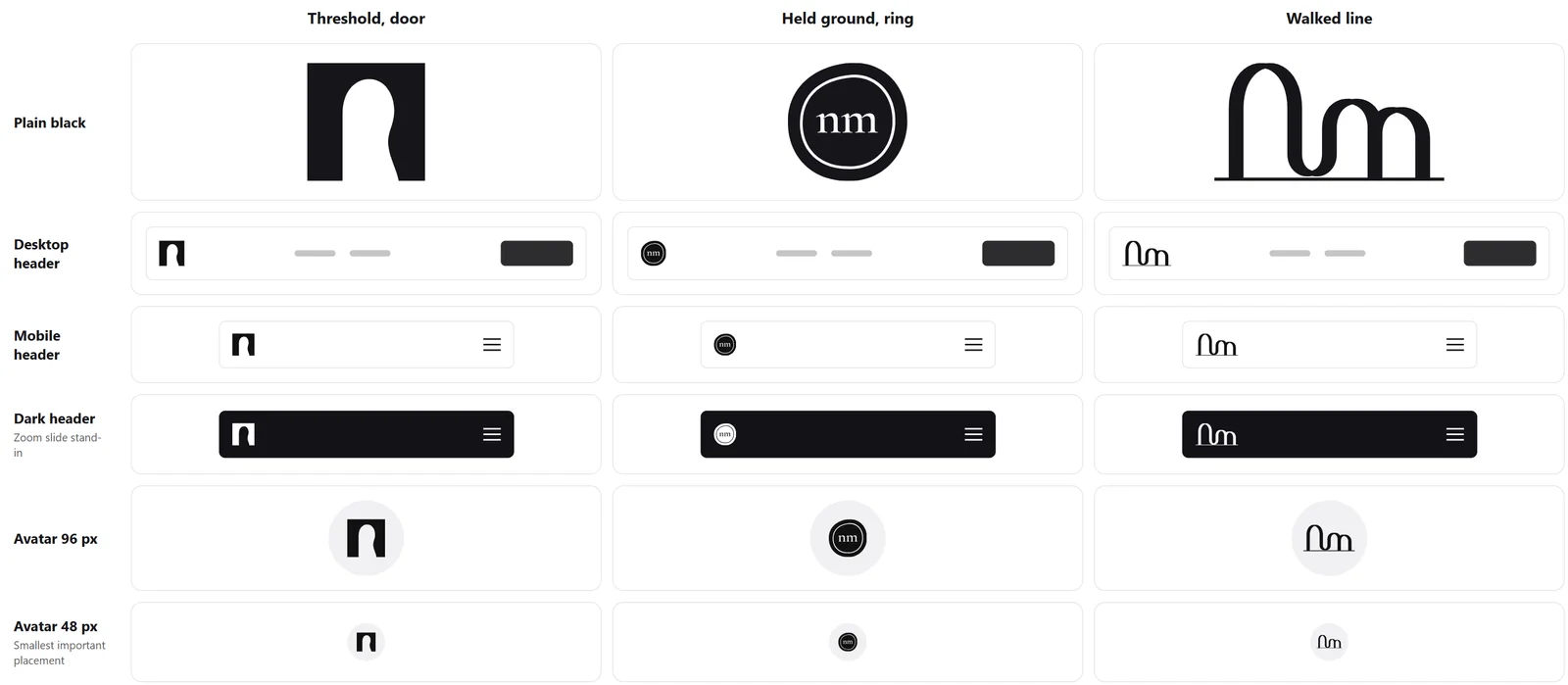
A real logo design process starts by setting tests the logo must pass. The drawing comes much later. This was the order on one job, for Nicola Mosley, a somatic therapist. Every step left a file behind, and you can see some of those files below.
- A written brief with five tests. It fails if it reads as a spa or a hospital. It fails on a stock leaf, lotus or peak. It fails on aggressive angles or any hint that it promises a cure. It must stay clear in a circle at 48 pixels, the size of a small profile picture. It must cover her whole practice, not only yoga or only therapy.
- Her words. We read what she had written and listed what she says often and never says. That ruled out heavy capitals, spa swirls and medical crosses before any drawing started.
- Twenty competitor logos, tallied. Plain names came up 8 times, script names 5, a peak or sun 4, a plant or tree 3, a seated figure 3. Some logos counted twice. In the judgement of Claude, the AI we used, 14 of the 20 could swap names with a neighbour.
- The profile-picture size test. We set her name in plain text at real sizes. It was barely readable at 48 pixels and unreadable at 32 pixels, so the logo needed a symbol that works without the full name.
- Three starting ideas. A doorway, a line walked across the land, and initials set inside a stone shape. Each explored a different question about her work.
- Drawn in black. No colour yet. We didn't want colour hiding a weak shape. A solid arch risked reading as a gravestone, so the doorway was cut from a block instead. Curved ground lines read as a smiling face, so they were redrawn.
- Real website test. Every version went into the top bar of the demo site we built for her, beside the button. A logo can look fine on a white sheet and feel empty up there. The version with a ring around it had the most presence.
- Fault-finding review. A fresh AI reviewer, shown only the design direction and the sheet of drawings, tried to find the faults in all three.
- Colour. A rust-coloured symbol with a dark name, using the colours set for her website. On dark backgrounds the symbol goes pale, never rust.
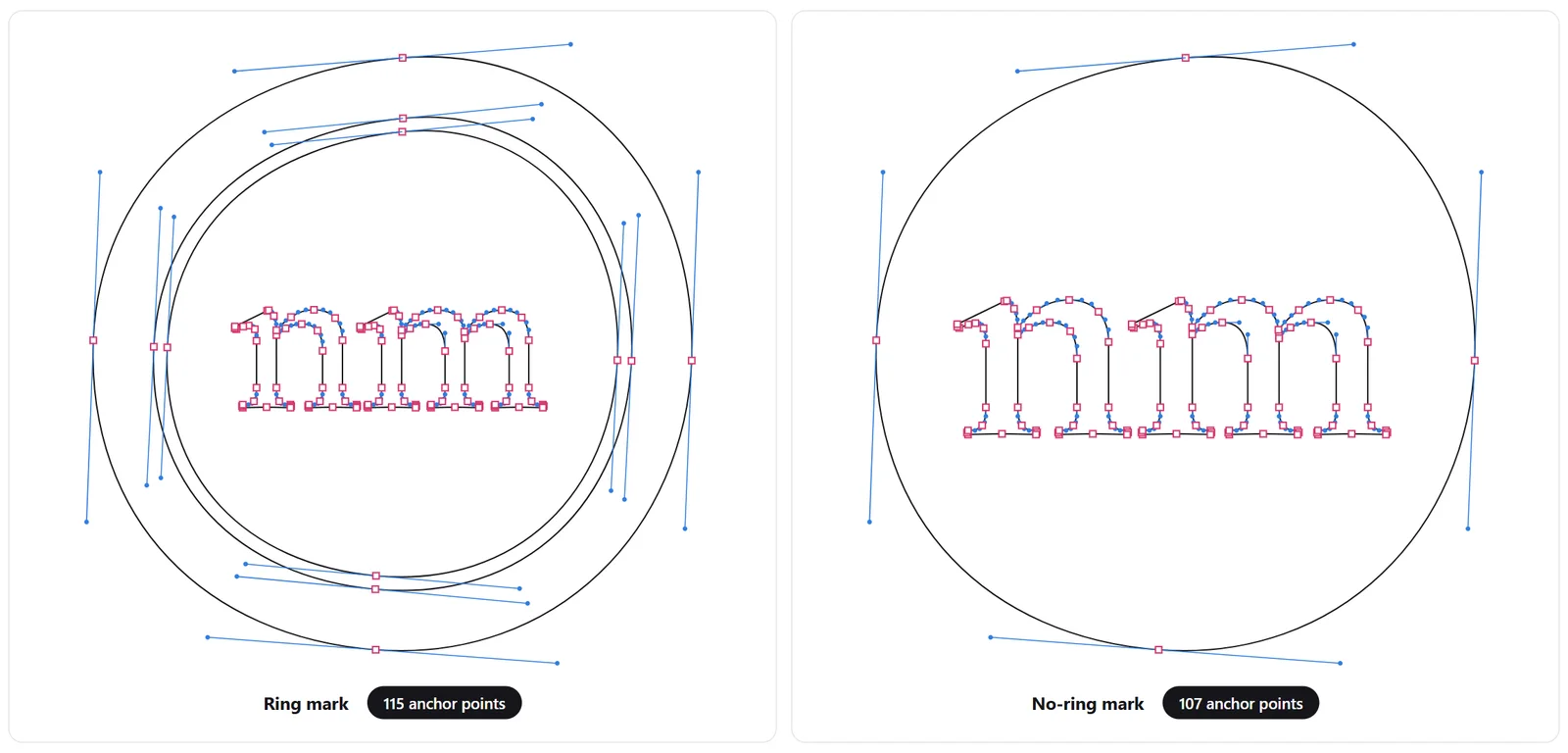
- A close look at the shapes. We looked at the points that make up each shape and fixed a kink where edges met, on the stone and on both ring edges.
- 42 finished files to hand over. Four versions: ring with name, no ring with name, ring alone, no ring alone. A guide opens first and says which file to use where. Checking at full size also caught tiny white slivers in the letters, which we fixed.
Free download: The logo brief checklist (PDF) has the questions we'd answer before drawing anything, whichever tool you use.
Wasn't this logo made with AI too?
Yes. This logo was drawn with Claude, an AI, under my direction. No person drew those shapes by hand. I approved the brief, argued with the results, and picked or rejected each design.
There are two reasons to say this plainly. It's true, and hiding it would undercut everything above. If you use ChatGPT, OpenAI's own terms also ban passing off its output as human-made when it wasn't. You should be able to ask anyone you hire which tools they used.
AI drew the logo in the one-prompt version and in this one. The difference was the work around it. If you're weighing that kind of choice for your whole site, our guide on website builder vs web designer walks through the same trade-off.
Where did the process push back?
The process pushed back three times, and not every problem got fixed. A process doesn't guarantee a perfect logo. It exposes problems while there's still time to decide what to do about them. It also leaves a record of what you accepted.
The McDonald's arches. Claude redrew her initials using doorway-shaped arches and recommended them. I objected. The letters had no breathing room, and the "m" looked like the McDonald's arches. Claude agreed and withdrew it. We went back to serif letters, the kind with small strokes at their ends, because two round arches side by side will always look like that.
The reviewer's fail verdict. The AI reviewer failed the version I'd picked. It said the ring and edge fade at 48 pixels, leaving initials in a dark circle. It called the symbol a closed seal and saw a jar lid and a stamp. We fixed the size problem with a no-ring version for small spots. We did not fix the closed seal, and I chose the ring knowing that.
The "generic" verdict. We then mixed the logo in with 20 others, in grey, and asked an AI, standing in for a person, for its first reaction. Its three words were "tidy, quiet, generic". That's an awkward verdict in a post about generic logos, which is why it's printed here. This logo was the third it noticed, but only because of the solid dark shape.
It also said the logo looked most like one other in the set, a circle symbol with a small serif name. Side by side at full size, the two were clearly different. The likeness showed mostly at small sizes. Claude suggested swapping the ring for a ground line. I didn't like it, so the ring stayed for larger spots and small spots use the no-ring version.
An AI's three words are not a customer's, so we also put this logo in front of real people.
Who owns a ChatGPT logo in Canada?
Nobody can give you a clear answer yet. OpenAI's terms give the output to you "to the extent permitted by applicable law", which leaves the question to the law. In Canada, that law isn't settled for AI-made work. Treat this as background, and ask a trademark agent or intellectual property lawyer before you rely on it.
In the US, the Copyright Office says copyright does not extend to "the mere provision of prompts". Creative changes made by a human can qualify. That's US law, but Canadian owners with US customers should know it.
In Canada, CIPPIC v Sahni, brought by the group CIPPIC, asks the Federal Court to remove an AI as an author on a copyright registration, or to cancel the registration. We found no ruling as of November 2026.
Trademark is a separate question, and it's the one to act on. Before you print anything, search Canada's trademark records through the trademark office, CIPO. Someone else may hold something close to what ChatGPT gave you. Our own process doesn't clear this either. That search is still on the list for this logo, before it goes to print.
When is a ChatGPT logo good enough?
A ChatGPT logo is good enough when being mistaken for someone else wouldn't cost you anything. That covers a test idea, a side project, a one-off event or an internal tool. It also works as a sketch to show a designer what you like. Spending real money on a logo for an idea you may drop in a month makes little sense.
It stops being enough when you compete locally on trust. If you run a shop in Surrey or a service business in Langley, your customers choose between names on a map. Your logo goes on trucks, signs and uniforms. Changing it later means reprinting all of that.
Try this on any logo you already have. Cover the name, then ask if it could belong to someone else in your trade. If it could, the scorecard above will show you where to start. Budgeting for the whole site at once? Our custom website design cost guide for BC lays out the numbers, and our web design team in Abbotsford can look at your logo alongside your site.
Frequently asked questions
Are ChatGPT logos copyrighted?
It's not settled. OpenAI gives you its output only as far as the law allows, and the US Copyright Office says prompts alone don't earn copyright. In Canada, we found no ruling as of November 2026. A trademark is a separate protection, so search for that too.
How much does a designer charge for a logo?
In Canada, freelance logos run from about $400 to $4,200, going by three current guides. Parabolic Studio lists independent freelancers at $400 to $1,500 and boutique studios at $1,500 to $4,500. Elevate Web Design lists premium freelancers at $800 to $3,500. Freel's cost guide says $750 to $4,200, based on national average rates. These figures come from people selling the service, so treat them as rough. Logos aren't on our pricing page, so ours is a custom quote after a free call.
What are the 7 types of logos?
The usual seven are wordmark, lettermark, pictorial mark, abstract mark, mascot, emblem and combination mark. The count isn't official. Printful's guide, for one, lists 10. The logo in this post is a combination mark: a symbol with the initials, plus the full name beside it.
What is the golden rule for logos?
There's no official golden rule. We'd ask whether the logo still looks like yours at small size, beside your competitors. That's why the logo in this post was tested early at 48 pixels and compared against 20 real logos in its category. A logo that only works large and alone hasn't been tested yet.
Can ChatGPT make a vector logo?
Not as a normal image, going by what OpenAI publishes. OpenAI's image API lists PNG, JPEG and WebP as its formats, and all three are pixels. ChatGPT can write SVG, a vector file type, as code in text, which suits simple shapes. Vector matters because, as MDN explains, SVG can be "rendered at any size without loss of quality". Signs and print shops often ask for vector files, so have them before you order.
Harman Chahal
Bring your logo along
A logo AI helped make can still do its job. The test is whether it stays yours at every size, next to the people you compete with.
If you're building or redoing your website, bring your logo along. We'll tell you honestly if it's holding you back. And if it's fine, we'll say that too.