

Quotable answer
Topical authority means your website covers a subject deeply enough that Google can see the pattern: one strong main page, useful supporting pages, real proof, and clear internal links. For a local business, that structure often matters more than repeating the same keyword ten more times.
Most business owners I talk to have the same theory about SEO: pick the right keyword, put it on the page enough times, and wait for Google to notice.
It sounds reasonable. It used to work better than it does now.
But if your website is not ranking, the problem is usually not that you used the keyword six times instead of nine. The deeper issue is that the page does not prove you understand the topic, the customer, or the decision the searcher is trying to make.
Google says its systems look at the meaning of a query, page relevance, usability, source expertise, and local context. It also says content should be useful, well organised, and written for people first, not mainly to manipulate rankings. Source: Google Search ranking results and Google helpful content guidance.
How do you build topical authority for a local business?
To build topical authority for a local business, your site has to cover a service the way someone experienced would explain it. Not with one thin page. Not with random blog posts. Not with a homepage that says "quality service" and leaves the details out.
For a local service business in BC, topical authority usually means a strong main service page, supporting articles that answer real customer questions, clear internal links, local proof, project examples, reviews, and related entities that naturally belong to the service.
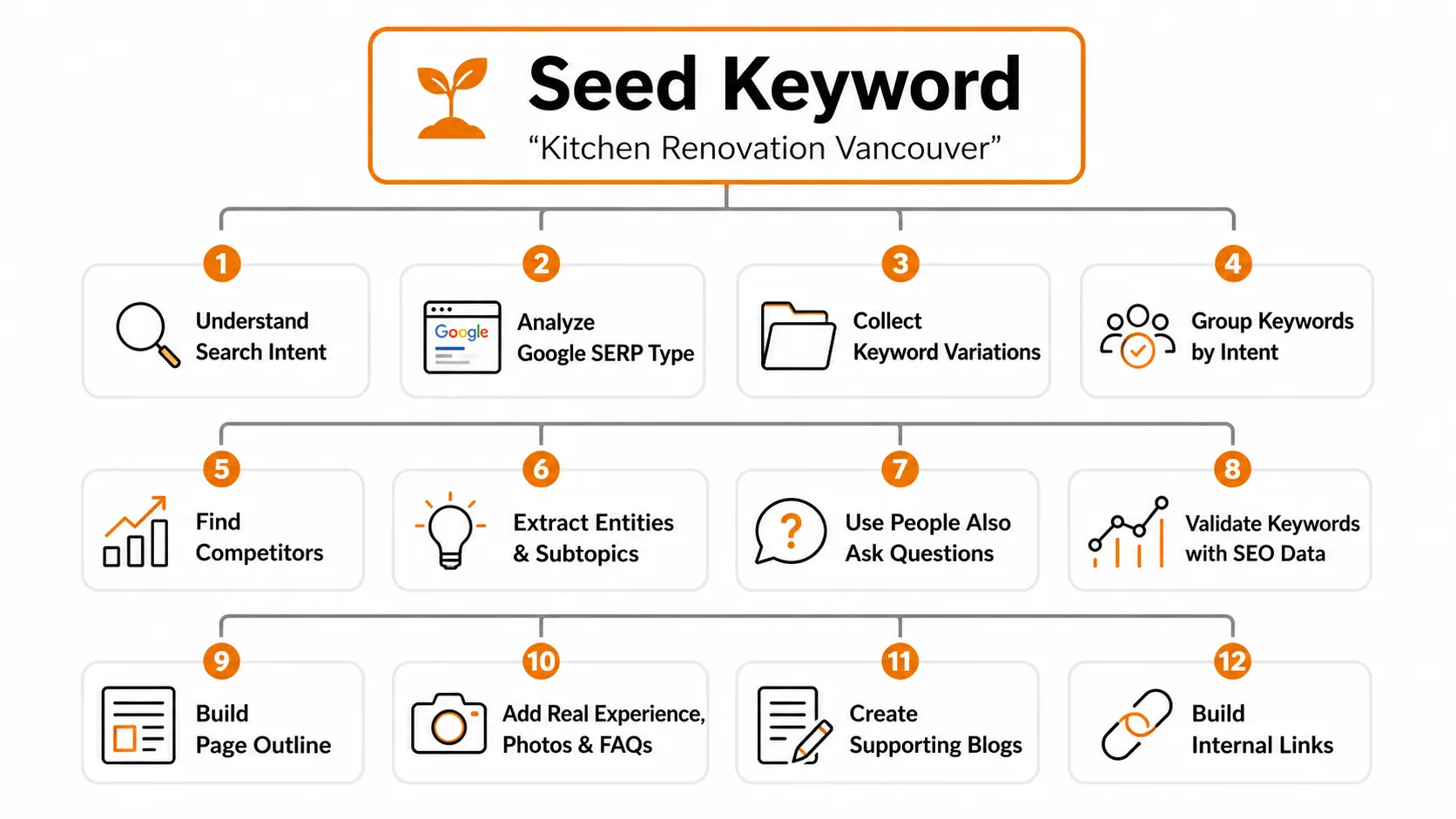
Take a kitchen renovation company in Vancouver. The obvious seed keyword is "kitchen renovation Vancouver." That searcher is not asking what a kitchen is. They are likely comparing contractors, checking price ranges, looking for photos, wondering about permits, and deciding who can be trusted inside their home.
One page can answer some of that. A proper content structure answers all of it without making one page bloated.
Why does keyword stuffing fail now?
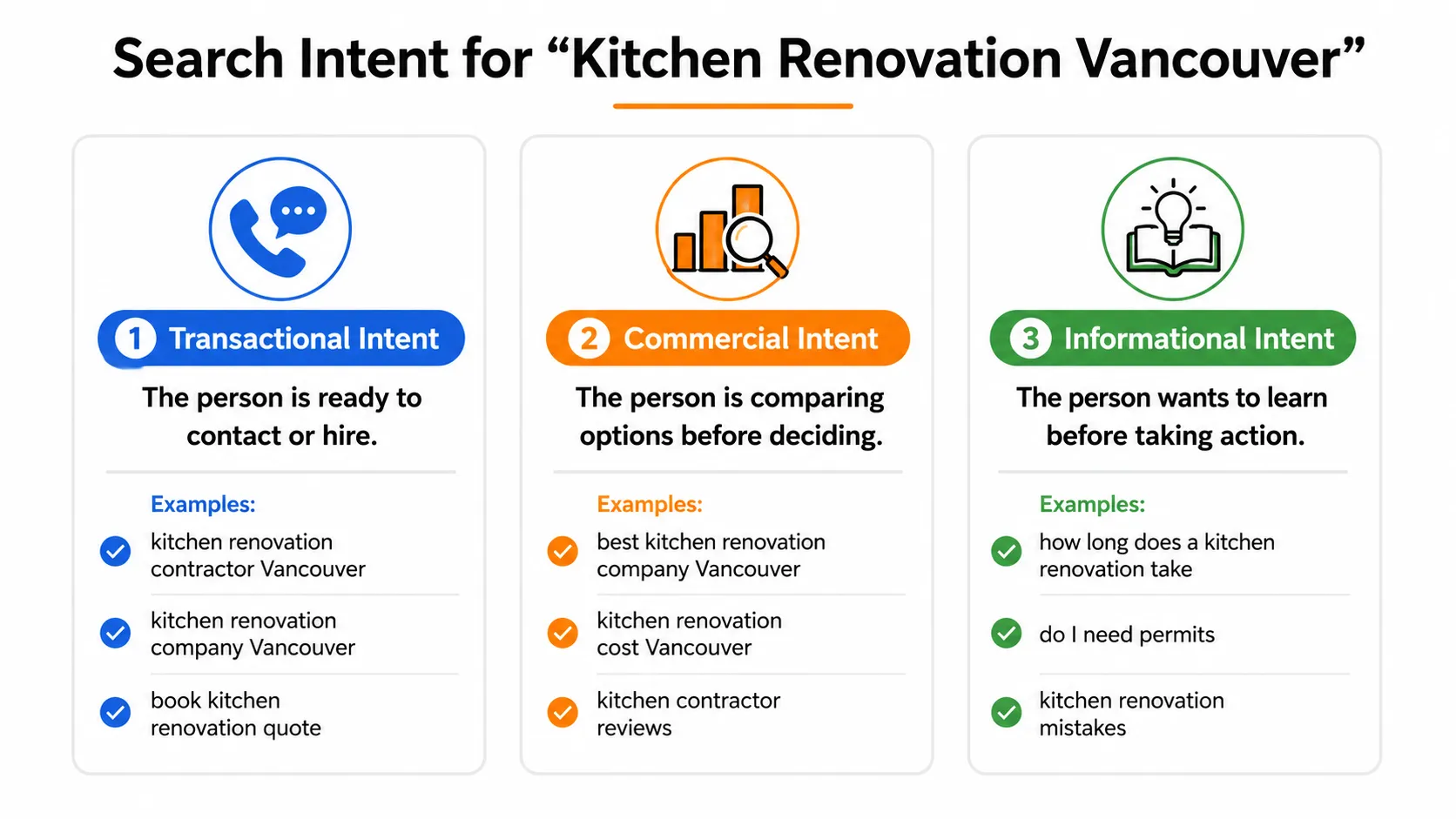
Keyword stuffing fails because it treats every search as the same intent. A person searching "kitchen renovation contractor Vancouver" is closer to hiring. A person searching "how long does a kitchen renovation take" is still researching. A person searching "quartz vs granite countertops" may be months away from a quote.
Those searches belong in the same topic cluster, but not always on the same page.
| Search type | Example keyword | Best page type | What the page should answer |
|---|---|---|---|
| Buying intent | kitchen renovation Vancouver | Main service page | Services, process, proof, areas served, CTA |
| Cost research | kitchen renovation cost Vancouver | Blog or cost guide | Budget ranges, cost factors, trade-offs |
| Process research | how long does a kitchen renovation take | Blog or FAQ | Timeline, delays, decision points |
| Materials research | quartz vs granite countertops | Comparison blog | Pros, cons, maintenance, fit |
| Trust research | kitchen renovation contractor reviews | Service page and case studies | Reviews, photos, credentials, past work |
This is the part that trips people up. They do keyword research, find 50 phrases, and push them all into one page. The page starts trying to be a service page, cost guide, permit guide, comparison article, and FAQ at the same time. It usually ranks for none of them.
The better move is to group keywords by intent. The service page should help the person who may call this week. Supporting blogs should help the person still learning. Each piece then links back to the page that deserves the lead.
How should you check search intent before writing?
Search intent is the real reason behind the query. Before writing, look at what Google already ranks for the keyword. Google is showing you the format it trusts for that search.
If the top results are service pages, you probably need a better service page. If the top results are guides, a blog post may fit. If the Map Pack dominates the screen, your Google Business Profile, local citations, reviews, and service-area signals matter alongside the website.
Google's own search documentation explains that serving results depends on matching pages to the user's query, location, language, device, and expected result type. Source: Google Search Central: how search works.
What related topics should the page cover?
A strong page should cover the entities and subtopics that naturally belong to the service. These are not magic keywords. They are signs that the page understands the work.
For a kitchen renovation page, those entities might include cabinets, countertops, backsplash, flooring, lighting, plumbing, electrical, permits, layout, storage, kitchen island, renovation timeline, renovation budget, and before-and-after photos.
If a kitchen renovation page never mentions cabinets, counters, layout, lighting, or permits, it feels thin. A reader notices that. Google can too.
This is why repeating "kitchen renovation Vancouver" over and over does less than people think. A page that explains the full service in plain language gives the searcher more help and gives Google more context.
What should the content structure look like?
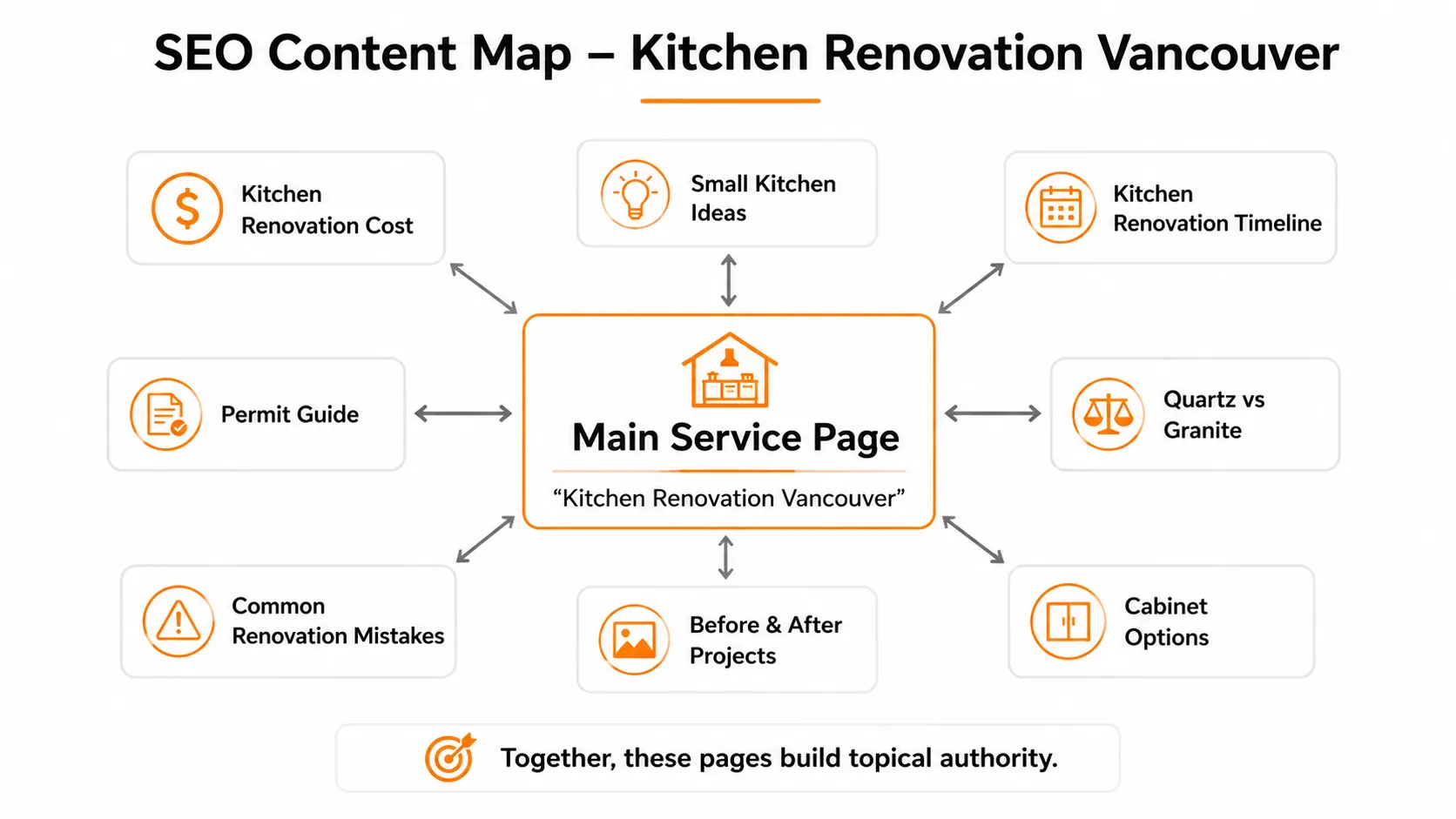
For a local service business, the structure should start with one clear money page. That page is the trunk. Supporting blogs are the branches. FAQs, images, reviews, and case studies are the leaves.
HTML infographic
A simple topical authority structure
Main service page
Built for the buying-intent searcher comparing providers or requesting a quote.
Supporting blogs
Cost guide, timeline guide, permit guide, materials comparison, mistake guide.
Internal links
Each support page links back to the main service page with natural, descriptive anchors.
Download guide
Topical authority checklist
A practical worksheet for mapping your main service page, support blogs, entities, and internal links before you write.
How do internal links build topical authority?
Internal links tell Google which pages are related and which page should carry the main authority. They also help customers move from learning to buying.
Google says link text tells users and Google what the linked page contains. It also says links help Google discover pages and give extra context around a topic. Source: Google SEO Starter Guide.
For the kitchen renovation example, the cost guide should link to the main kitchen renovation page. The permit guide should do the same. The countertop comparison should link back too. The main service page can also link out to those guides where the reader needs more detail.
This is how we think about SEO services for small businesses at IshaanEx Digital. The page is not isolated. It has to connect to on-page SEO, local SEO services, AI search optimisation, and the website design work that makes the page easy to trust.
That same structure matters on city pages too. A strong SEO Abbotsford page should not compete with the main SEO pillar. It should prove local relevance for Abbotsford businesses, then link back to broader guides like this one when the reader needs the strategy behind the page structure.
What real proof should you add?
Topical authority is not only about more content. It is about content that proves the business is real.
For service businesses, proof can include named services, real project photos, reviews, neighbourhoods served, process steps, timelines, pricing ranges, common mistakes, before-and-after examples, and founder or team experience.
From IshaanEx projects
The narrow-focus lesson is real. Super Sanitation ranks #1 business result for "sanitation services Abbotsford" because the website stayed focused on industrial and food-plant sanitation instead of broad cleaning. DELANA Interiors also ranks #1 in the West Vancouver Map Pack for "kitchen renovation west vancouver." In both cases, the structure matched the specific service intent.
How does this connect to AI search?
AI search systems also need clear structure. Google AI Overviews, ChatGPT search, Perplexity, and other answer engines pull from pages they can understand and cite.
That does not mean you need weird AI-only copy. It means the same strong SEO structure matters more: clear headings, direct answers, service definitions, real proof, author information, descriptive images, entity-rich content, and internal links.
Google recommends Article structured data for blog pages because it can help Google understand the page title, image, date, and author. It also recommends author markup fields such as author URL or sameAs to help connect the author to a real person. Source: Google Article structured data.
For IshaanEx, this is why the SEO cluster has to work as a system. The main SEO services page carries the broad small-business SEO topic. The SEO Abbotsford, SEO Burnaby, SEO Surrey, and SEO Vancouver pages prove city relevance. The West Vancouver service area page carries real project proof through DELANA Interiors. This guide sits between them as the educational support page that explains why the structure works.
Frequently asked questions about topical authority
What is topical authority in SEO?
Topical authority is the trust your site builds by covering one subject deeply and clearly. For a local business, that usually means one strong main service page, supporting blogs, real proof, and internal links that connect the topic together.
Why is my website not ranking even though I used keywords?
Your website may not be ranking because the page does not match the search intent. It may also be too thin, missing service details, lacking proof, or disconnected from supporting pages. Keywords help, but they cannot replace a proper content structure.
How many blog posts do I need to build topical authority?
There is no fixed number. Start with the questions customers ask before hiring: cost, timeline, process, permits, comparisons, and common mistakes. For many local service businesses, five to ten strong support articles around one main service page is a better start than 30 random posts.
Should every keyword get its own page?
No. Every search intent needs a home, but not every keyword needs a separate page. Group keywords by what the searcher wants. Put buying-intent terms on service pages, research questions in blogs, and smaller objections in FAQs.
Do internal links really matter for topical authority?
Yes. Internal links help Google discover related pages and understand which page is central to the topic. They also help customers move from a blog post to the service page when they are ready to compare options or book a call.
Is topical authority different from local SEO?
Yes, but they work together. Local SEO focuses on maps, service areas, citations, reviews, and local relevance. Topical authority focuses on how deeply your website covers the service. A local business usually needs both to compete.

Harman Chahal
Want to know why your website is not ranking?
IshaanEx Digital can review your website structure, service pages, Google Business Profile, internal links, and AI-search readiness. Start with the SEO services overview, or go straight to the local page for SEO Abbotsford if you want the city-specific version of this strategy.